

A new buzz phrase is making the rounds in the travel industry, and it applies to those of us with the cruising bug: traveling with intention.
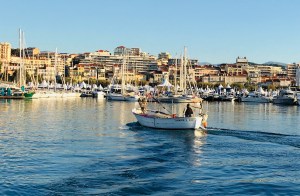
The best way to explain this is to give an example. I am a Greekophile (I’m also an Anglophile, a Francophile, an Italophile and a bunch of other –philes). My wife and I were cruising the Greek Islands with some friends, a former British Airways captain and his wife. We were Med-moored and stern-to the quay on Hydra in the Saronic Islands on his 50-footer. It was morning, and I had made the trek to the nearby bakery that had to-die-for bougatsa, the flaky Greek breakfast pastry filled with creamy chocolate semolina custard.
We were lazing in the cockpit, enjoying that treat with iced Greek coffee and considering which island we would move to that afternoon. The pilot/boat owner posed the question: “So, where to?”
Almost simultaneously, the rest of us said, “Why?” The result, besides a burst of laughter, was that we stayed tucked to the quay on Hydra for several more days. We were cruising with intention.
If you are of a certain age, you may recognize the 1969 film If It’s Tuesday, This Must Be Belgium, about a group of American tourists rushing through Europe on a whirlwind bus tour. That is the exact opposite of traveling with intention.
Traveling with intention is the reason why savvy travelers are opting for villas rather than hotel rooms, choosing to stay in one place and immerse themselves in the destination in its purest form. Far too many cruisers seem to be on autopilot, mindlessly racing from island to island, port to port. They return from a cruise needing a vacation from what should have been the vacation.
On Hydra, we met and enjoyed the people moored nearby along the quay, invited them for sundowners, and learned about who they were, where they’d been and where they were headed. And I was quickly on a first-name basis with Andreas, who ran the bakery and who would have a bag of bougatsa ready when I walked over each morning.
Hydra is the home of the Greek Merchant Marine Academy, the oldest such school in the world. Greek ship captains traditionally return to share their wisdom there. I discovered that they also often gather at a pub in the afternoons, sitting at a waterfront table, sipping ouzo and telling stories.
Most speak fluent English. When they recognized me as an amerikanós kapetánios (American captain), they invited me to join them. I learned two things: They were amusingly brutal in their critiques of boat handling nearby, and they could put away ouzo by the gallon. My first ouzo hangover was memorable. But when we were finally departing from Hydra, they all walked over to toss our lines (and point out what we were doing wrong). They had become friends.
This ability to feel a sense of belonging in a foreign city is essential to mental and physical regeneration, and it turns cruises into something beyond bringing postcards and trinkets home.
The Italians, who have been traveling with intention for centuries longer than us, even have a word for it: villeggiatura, which they define as a prolonged stay in a single place. They have long understood that there is more to life than just ticking off a checklist of tourist attractions on a bucket list. By taking the time to immerse yourself in your “wherever,” you also rid yourself of FOMO. The fond memories of my Greek captains kibitzing on the waterfront (though not-so-fond of the ouzo) linger far longer than if we’d moved on to see some Greek ruins on another island.
I will admit that I used to be part of the If It’s Tuesday… crowd. On a seven-day bareboat charter, we would hit seven islands and, sadly, sometimes even more. I had each trip planned, almost waypointed, long before we set foot on the charter yacht. There were no surprises, and those memories have long faded.
Yet, I can still smell the pipe smoke from my Greek captains, and their laughter as a Greek Navy tug struggled to get its lines ashore in a mild meltemi wind.
Try cruising with intention. I guarantee you’ll love it.
This article originally appeared in the November/December 2026 issue of Passagemaker magazine.