

A family tragedy helped us realize that life is short, and that it can be a lot better on a boat.
Story + Photos by Ed Poltonowicz
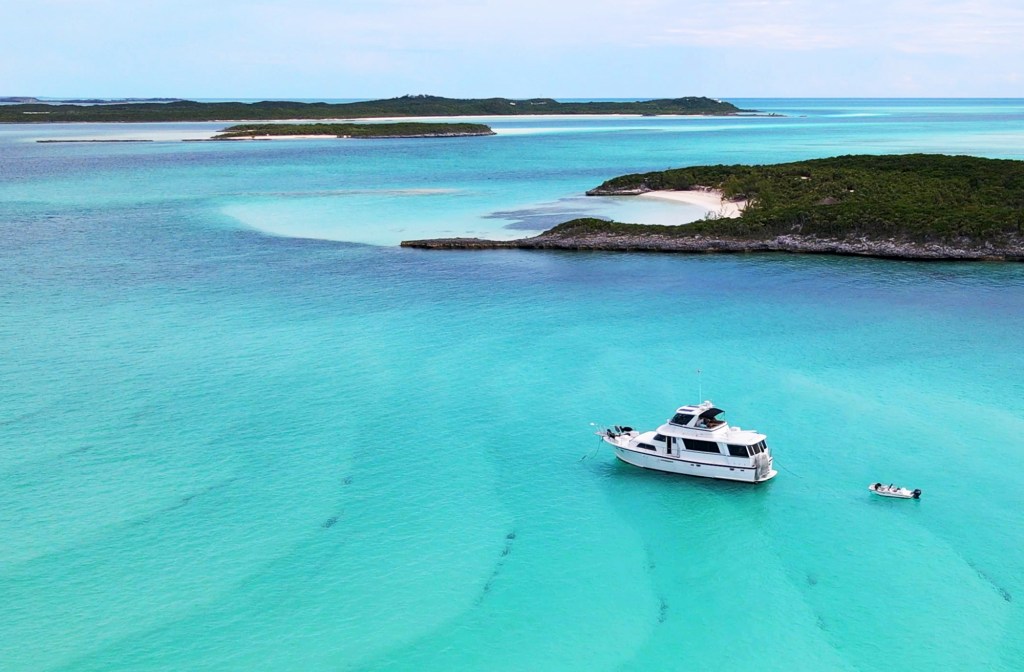
The sun was sinking low off Soldier Cay, painting the Bahamian water in shades of gold and blue. The view hardly seemed real. My wife, Lyn, handed me a martini. For a moment, everything was still. In the anchorage, it was just us, our boat and the quiet rhythm of the sea.
I couldn’t help but think about how a single tragedy had steered our lives toward extraordinary adventure, and about how easily that tragedy could have sent us on a different path.
The call had come in at 4 p.m. on a cold April afternoon. It was the New Jersey State Police. My brother’s boat, a 22-foot Wellcraft, was circling aimlessly in the Delaware River just north of Philadelphia. There was no captain aboard. Two fishermen had reported seeing my brother leave Neshaminy State Marina in nearby Bristol, Pa. Shortly after, the boat was said to have been caught in the wake of a passing tug, and he went overboard. He was alone and not wearing a life jacket.
A monthlong search down the river ultimately located my brother, 12 miles downstream. We had already given up hope. We’d held a memorial service the day before to help bring closure. Afterward, my family members flew back to their respective cities. That’s when the call came from the coroner. True to form, my brother was a day late to his own funeral.
Several months later, Lyn and I found ourselves at the Fort Lauderdale International Boat Show. We had always dreamed of owning our own boat. You’d think such a tragedy would have ended that dream, but it had the opposite effect. Life is short, and you never know when your number’s up. It was time to rebalance our priorities.
Saving for the future had always been important, but we realized that living for today deserved a place much closer to the top of the list. Apparently, one of the stages of grief is buying a boat. So, at 54 years old, we bought our first boat, a Carver 355 we named Reprisal.
We had no idea how to operate this boat, so we hired a captain to deliver her to a marina near our home. It was the same marina where my brother had kept his boat. It was late winter, and the marina was nearly deserted. The day after Reprisal was delivered, Lyn and I were sitting on the aft deck, sipping martinis, when we heard a smash. We turned to see a sailboat that had rammed into a finger pier. A minute later, there was another smash. That’s when it hit me: This person wasn’t having a bad day. He was a genius. With the marina practically empty, it was the perfect time to practice docking.
The next day, we gave that same thing a try. With all the courage we could muster, we untied the lines, eased out of the slip and ventured into the fairway. That became our routine for the rest of the week—dock, cast off, repeat—until the procedure finally started to feel natural.
“We got this,” I said to Lyn one morning. “Let’s go on an adventure. How about Annapolis?”
And that was it. We never looked back. A few weeks later, we were cruising through Long Island Sound, bound for Martha’s Vineyard. We were hooked.
My mother was not pleased. After losing one son to a boating accident, the idea of her other son taking to the water didn’t exactly bring comfort. “Let’s post videos on YouTube,” Lyn said. “That way, your mom can see we’re being safe, wearing life jackets, following the rules.”
Just like that, our YouTube channel, “Trying Not to Sink,” was born. Nine years, 45,000 subscribers, 10 million views and 25,000 nautical miles later, we’re still out here, filling that unforgiving minute with 60 seconds of distance run.
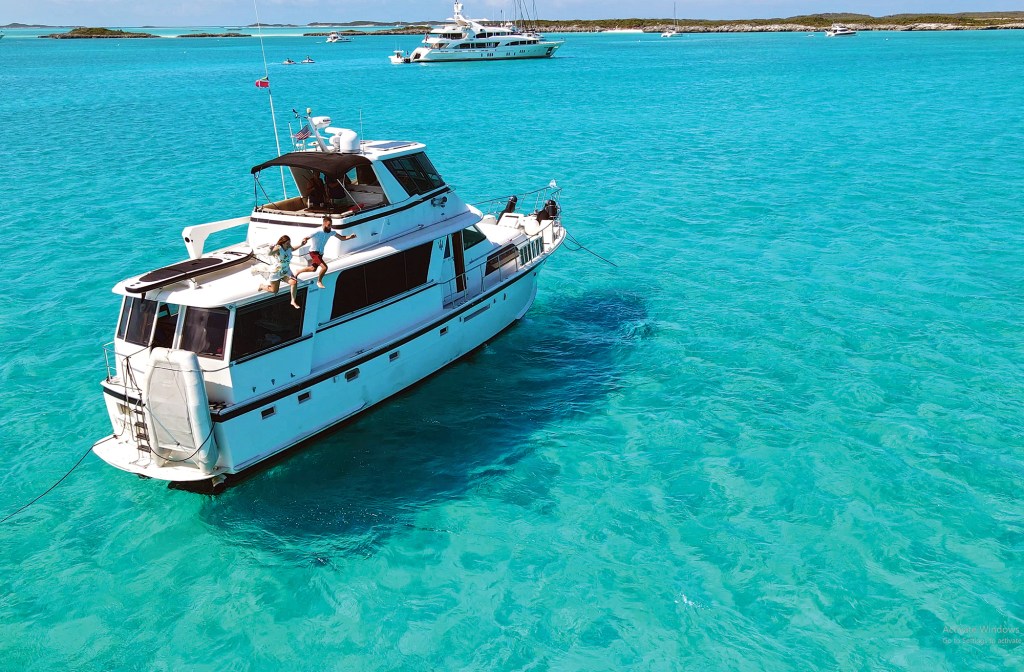
And we’ve upgraded to a bigger boat. We loved the Carver, but always knew it was our starter boat. It took us a dozen or so disappointing showings, but finally, we found our next ride: a Hatteras 58 Motor Yacht.
She was originally commissioned by Nicholas Douvas, an ophthalmologist who invented a device to remove cataracts, saving countless people from blindness. The original Hatteras wall plaque, bearing the same name as his device, Roto-Extractor, still hangs in the lower helm.
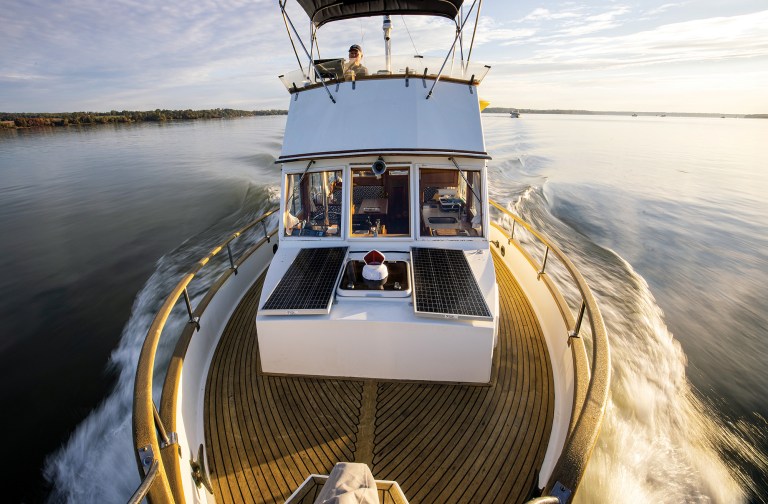
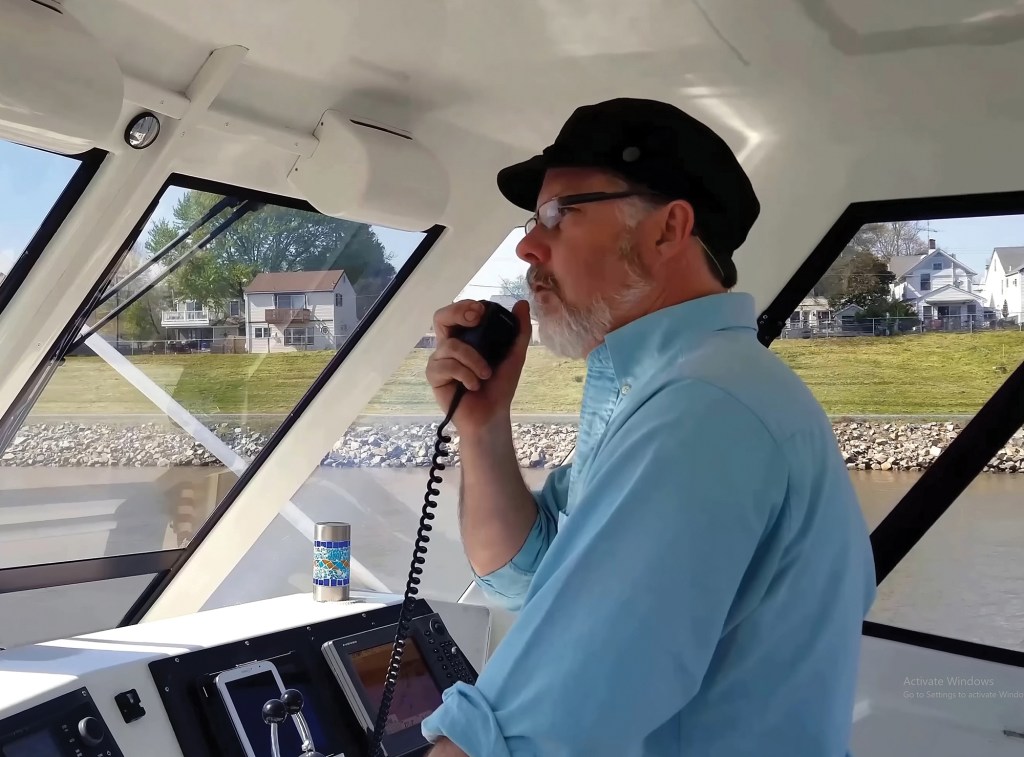
In 2016, I became her third captain and we renamed her Triton. Technically, she’s a semi-displacement boat, but we treat her more like a trawler. Ten knots is our regular cruising speed. She’ll climb up on plane if we don’t mind throwing our wallet out the back of the boat. I joke that if I wanted to get somewhere fast, I’d have bought an airplane.
Triton has four staterooms, four heads and a galley-up layout—something that was especially important to Lyn. As a culinary enthusiast who loves creating gourmet meals, she didn’t want to be tucked away down below while everyone else was gathered in the salon.
We kept Triton in Philadelphia at Penn’s Landing for the first several years. We enjoyed having our boat-condo just blocks from some of the most historic parts of our country, not to mention the vibrant restaurant and bar scene.
What an adventure it’s been. Each season, we’d travel down the Intracoastal Waterway to Florida and then hop across the Gulf Stream to the Bahamas. On the ICW, we usually stay at marinas, though we do go outside to the ocean when the weather cooperates. For us, the real joy is exploring the little towns, meeting the locals and soaking in the character at each stop. It’s a lot easier to do that when you’re tied up in a slip.
Once in Florida, we stock up for the Bahamas, where grocery prices can be, well, eye-opening. We usually spend two months in the islands each season, so preparation is key.
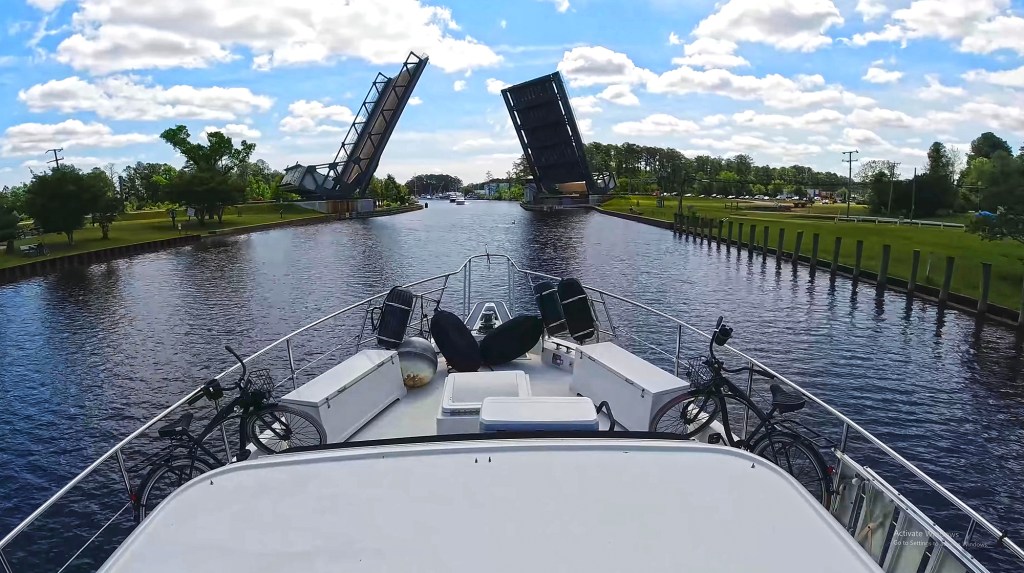
That first Gulf Stream crossing was nerve-racking, mostly because we didn’t know what to expect. Now, after a dozen or so crossings, it’s no big deal. Just wait for a good weather window and no north wind. We also discovered that we loved exploring the Bahamas so much that we decided to move our permanent slip to Florida. This way, we can reach the islands faster and spend more time there. Titusville Marina is now our home port. Each year, we spend six months on the water and six months on land. Lyn likes to call it our “surf and turf” lifestyle.
When we’re off to the Bahamas, our favorite place to check in is West End on Grand Bahama Island. From West End, we usually set our course for the Abacos. While we tend to stay in marinas when cruising the States, in the Bahamas you’ll mostly find us on the hook. One exception is Green Turtle Cay, a beautiful, friendly island with plenty to see and do. Our favorite way to explore is by golf cart, bouncing down narrow roads shaded by palm trees and lined with pastel cottages.
If you visit, get breakfast at the liquor store. No kidding. It’s one of those quirky little local experiences that makes you smile and reminds you that you’re definitely not in Florida anymore.
Another favorite stop is Spanish Wells, tucked at the northern end of the Eleuthera chain. We grab a slip at the marina, rent a golf cart and head off exploring. Somehow, we always end the day at Budda’s, raising a glass with fellow travelers and swapping sea stories until the sun dips below the horizon.
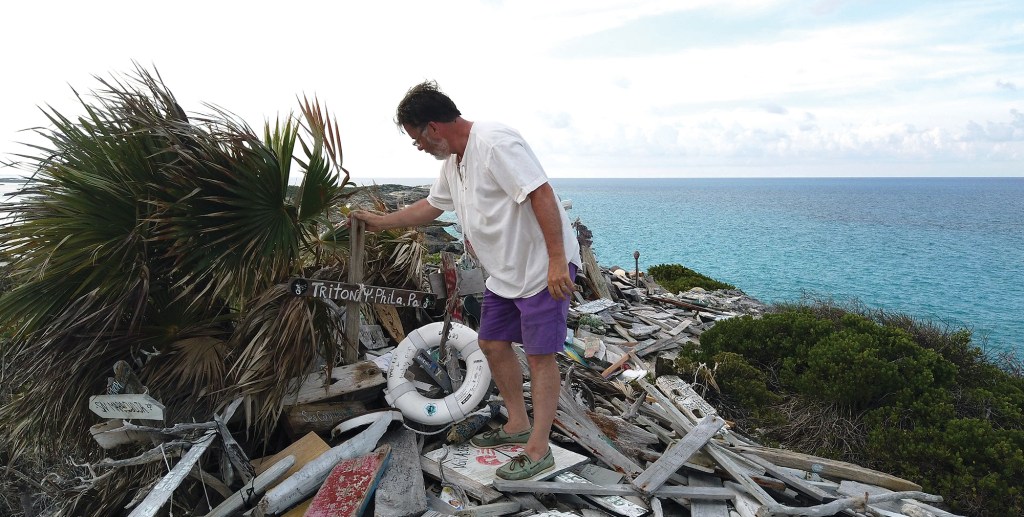
Sometimes it’s just Lyn, me and our guests—the only people on an island—surrounded by turquoise water so clear that it looks lit from below. Other times, we’re anchored in a field of fellow cruisers, all of us enjoying cocktails and another perfect Bahamian sunset. From climbing Boo Boo Hill to leaving our Triton sign at the top of the hill to snorkeling Thunderball Grotto at Staniel Cay to diving the underwater mermaid at Rudder Cut Cay, nothing compares to the Bahamas.
We often count our blessings and remember how grateful we are to have taken a chance on this life. As Lyn likes to say, “When was the last time you did something for the first time?” For us, that’s almost every single day.
Buying a boat and stepping into this extraordinary adventure was one of the best decisions we ever made. I like to think my brother would approve.
This article originally appeared in the April 2026 issue of Passagemaker magazine.
![QQ图片20200630131922[9][1][3]](https://s3.amazonaws.com/media.passagemaker.com/wp-content/uploads/2025/02/25214717/qq20200630131922913.jpg?w=300 "QQ图片20200630131922[9][1][3]")