

Time and Again
Three things in the late 1980s led to the creation of the original Nordhavn 46. The first was that designer Al Mason got annoyed with the boys.
Mason had been working with brothers Jeff and Jim Leishman for about a decade, building about 200 sailboats before consumer demand softened for sailing in general. The young Leishmans wanted to evolve some concepts, but Mason, who was older, resisted.
“We were asking him to do design changes and things that he didn’t really like doing,” says Jim Leishman, owner and vice president at Nordhavn. “In those days, it was ink on vellum. It was time-consuming. You had to redraw the entire boat if you wanted to change something in the galley.”
The second thing was that Jeff Leishman was completing his final project for a correspondence course with the Yacht Design Institute in Maine, to earn his degree in naval architecture. His assignment was to design something different than a sailboat: a full-displacement powerboat.
“We were trying to come up with something that could go across the Pacific, but with less physical effort, less exposure to the elements, less risk,” Leishman says. “We wanted to build a boat that would provide a better experience.”
The third thing was that Jim Leishman was putting about 6,000 miles under the keel of a 63-foot motorsailer the team had built, but couldn’t sell. They ended up taking it to the Annapolis, Fort Lauderdale and Houston boat shows before finally finding a buyer in New York.
“You could motor that boat at 8 knots. It had range and good fuel capacity,” Leishman says. “And I thought, this is great with the comfort level. You don’t have to really raise the sails other than the main to stabilize it. The whole thing got me to thinking.”
The Leishman brothers ended up designing what they thought was the perfect boat. “We put a huge amount of passion into that design, even though we didn’t even know if we were going to build it,” Leishman says. “That evolved into the Nordhavn 46.”
It was the first design they ever did entirely on their own, and once it hit the magazines of the day, customers flooded in. People were tearing out pages and snail-mailing them to learn more. “We were just flooded with inquiries,” Leishman says. “It was like nothing we had ever seen.”
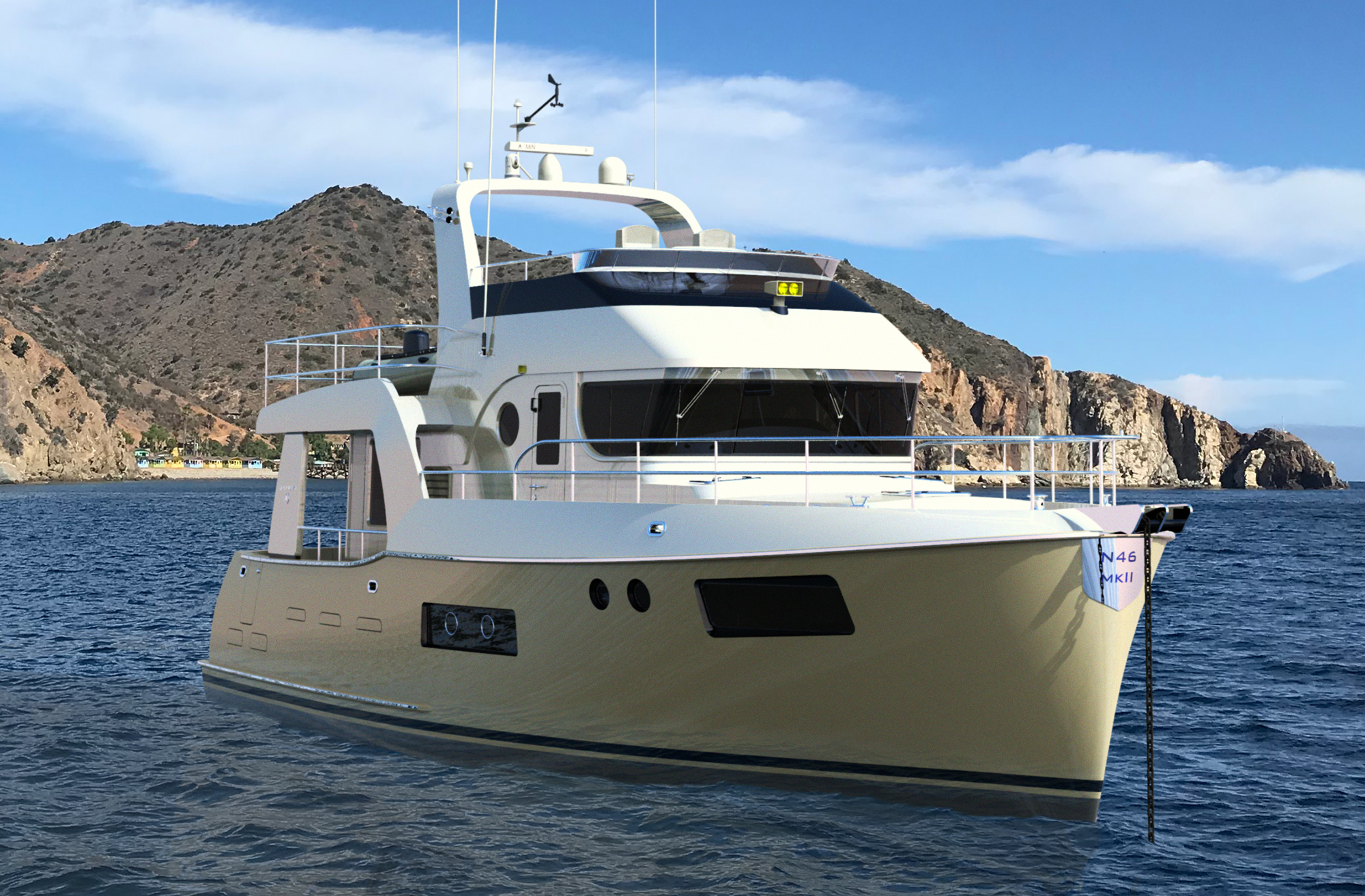
They ended up building about 90 hulls of the Nordhavn 46—and now, nearly 40 years later, they’ve reimagined that model using all the knowledge, advancements and inventions that have amassed in the decades since.
“This is special to come back to the roots, to the boat that started it all, the Nordhavn 46,” Leishman says. “A lot of the same people that worked on that original 46 are in the factory working on this. We used things that we never had access to before.”
The Nordhavn 46 Mark II is designed on a computer using computational fluid dynamics, a method that allows infinite possibilities for tweaks and changes compared to old-school physical tank tests. Leishman says Nordhavn’s team was able not only to update the aesthetics, but also to lengthen the waterline, gain interior volume and increase efficiency.
Where the original Nordhavn 46 had a single screw, the Mark II has twins. “It used to be that the single engine was the only way to get the range we wanted,” Leishman says. “The twin-engine boats were consuming 25 to 30 percent more fuel. That boat can’t meet the mission profile. You can’t be a passagemaking boat without a range approaching 3,000 miles.”
With the way today’s props, shafts and rudders are designed, along with modern engine features such as turbo-cooling and fuel injection, he says, twins can now exceed single-
engine efficiency with the same underbody design that’s used on the N41 and N51. Nordhavn also added a Hypro power-steering system to enhance responsiveness at the helm.
This setup also helps to decrease noise, because cavitation is lessened. The result is less vibration and sound. Combined with modern insulation in construction, the reduction in cavitation means the Mark II is a quieter ride.
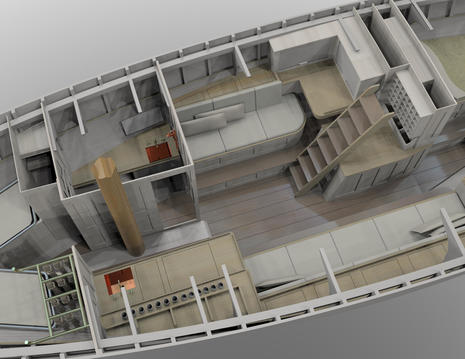
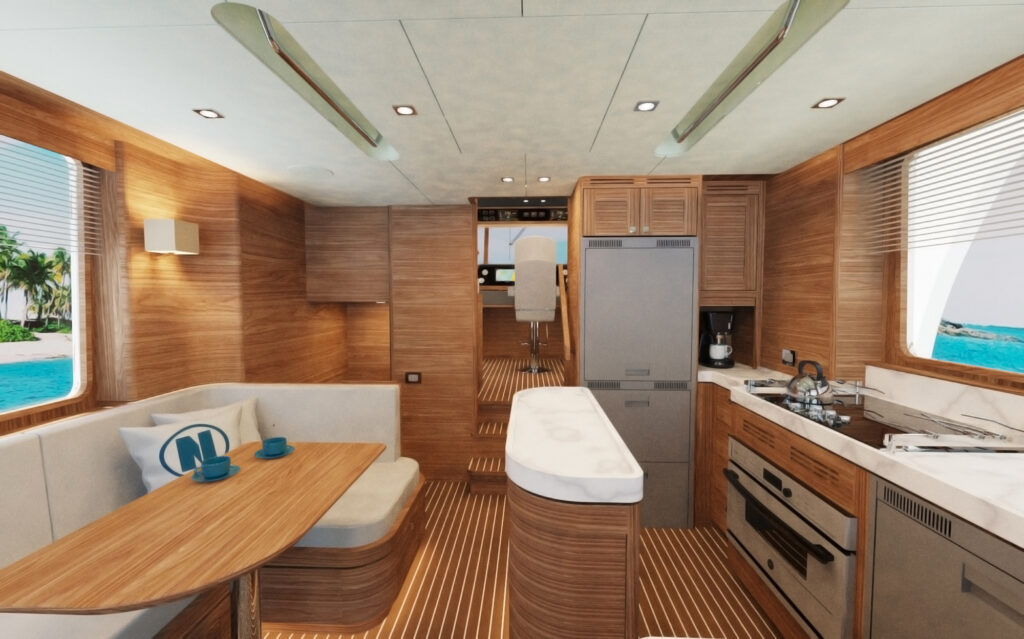
The extra waterline, in tandem with modern materials and construction techniques, also translates into more interior volume. Whereas the original N46 had a little more than 1,000 gallons of fuel, tankage on the Mark II is about 1,240—more than a 20% increase. And the Nordhavn team achieved that while adding a nearly walk-in engine room.
“When we designed the 46, Jeff and I were in our 30s and we’d been messing around on sailboats forever. An engine room you could crawl into was a dream for us,” Leishman says. “Now, we’re 70 years old and that’s not so great. This is radically better. You can basically stand up with your head just bent a little bit. The access to the machinery is fantastic.”
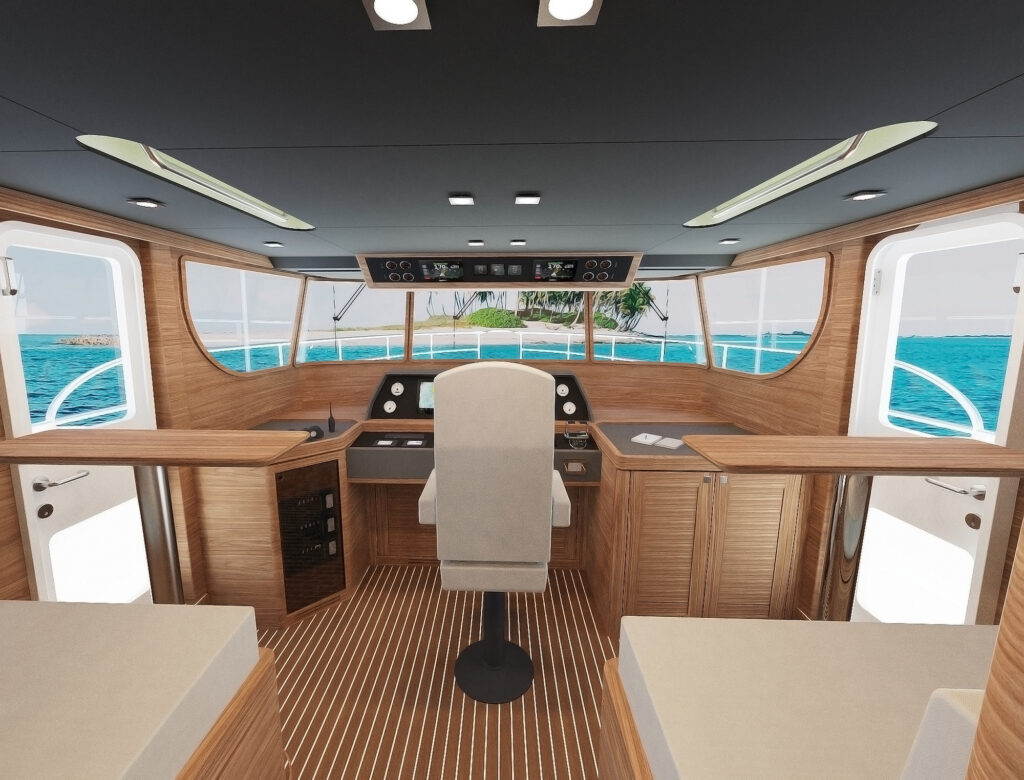
A modern electrical system, along with lithium-ion batteries, means there can be proportional control for thrusters, longer stretches of time without needing to run the generator and more.
“The boat has a beautiful stabilizing system that’s standard,” Leishman says. “It has air conditioning. It has diesel heat. It has good anchoring gear. The only thing this boat is lacking is a tender, which you have to select, but it comes with a davit to get the tender on and off.”
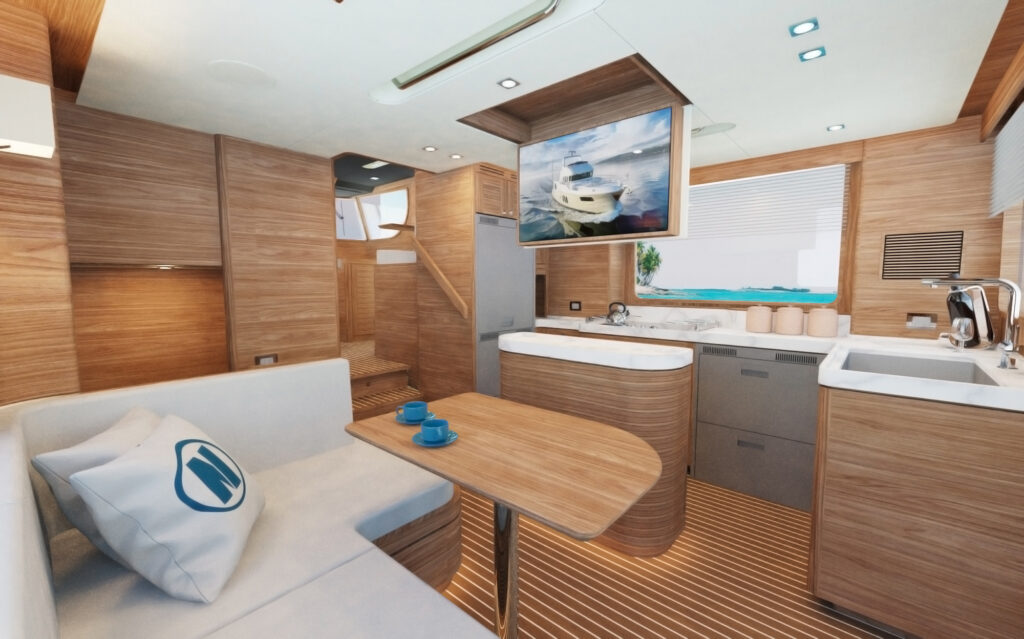
Owners also have to choose a watermaker (DC or AC). But pretty much everything else comes standard, including a full-size washer/dryer. The idea, Leishman says, is to outfit the Mark II to match how today’s cruisers want to spend their time.
“We have some younger people who are on these boats. They’re in their late 30s, maybe early 40s, and they’re doing it and making a living off the boat with Starlink and everything that’s available now,” he says. “People can get one of these boats and go off and conduct business.”
The only thing Nordhavn aficionados might think of as missing, he says, is the Portuguese bridge from the original N46. It’s gone because the team wanted to gain interior headroom belowdecks forward.
“On the original 46, we had little spaces, hanging lockers, bunks that were narrow,” Leishman says. “That was OK for a person who was comparing it to sailboats of the era, but now, people want queen-size beds and as much comfort as they can get.”
As of October, Nordhavn had signed letters of intent and taken a few deposits, with the first contracts for the N46 Mark II being signed. Hull No. 1 was expected to be completed in January, with a possible appearance at February’s Miami International Boat Show. Hull No. 2 was under construction, with Hull No. 3 ready for layup.
Nordhavn expects to build about a half dozen of the N46 Mark IIs in 2026—but could build a dozen if demand is there. The team, Leishman says, has to wait and see how consumers respond.
Because even after all these years, some things never change.
Nordhavn N46 Mark II Specifications:
LOA: 46ft. 3in.
Beam: 15ft. 10in.
Draft: 4ft. 9in.
Displacement: 57,498 lbs.
Fuel: 1,200 gal.
Water: 400 gal.
Engines: 2x 135-hp
Nanni N4.140
Info: nordhavn.com
This article originally appeared in the January/February 2026 issue of Passagemaker magazine.