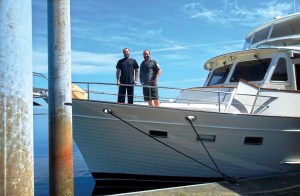


It was just another boat test, this time on a 50ish-foot trawler from the proud builders who were aboard to make sure I got my story right.
I’d been up in the pilothouse sharing ex-Coastie stories with the captain, a grizzled former U.S. Coast Guard chief. I decided to go aft as we headed out of the inlet. I was partly across the salon, which was carpeted by a plush and, I assumed, expensive carpet, when I noticed something odd: My Top-Siders were making the same sort of squirk sound as when I’d accidentally stepped on a Twinkie.
Just as I realized the carpet was melting, I heard one engine stumble. Everything at the helm went off: lights, alarms and, judging by the speed with which the skipper spun the wheel toward the harbor, perhaps an electric cattle prod in his helm seat. We had an engine-room fire.
The short version of this story is that the harbor patrol put out the fire quickly—an inverter panel had torched everything—and we were soon tied up at the dock. Sadly, the interior designer had put her Louis Vuitton purse next to her salon seat. When she tried to pick up the bag, it was welded to the carpet.
That melted carpet story is just one of my boat-test blues.
Readers often think that being a boating journalist is right up there with being the taste-tester for Ben & Jerry’s ice cream, or the sampler for Moët & Chandon. There are visions of days spent lolling on boats before returning to legendary quays in Saint-Tropez or St. Barts, where we stay in five-star suites.
Au contraire, mon ami.
What we actually do is climb into hot, cramped engine rooms designed for miniature engineers. Inevitably, a patch of our bare skin fuses to the one red-hot spot on the engine, generator, whatever. We then get a smear of indelibly black oil on our khaki shorts, which becomes a telltale sign for other boat-testers: “Oh, I see that you’ve tested the Mugwump 42 and found that oil filter.”
Another reality of testing boats is that some blood must flow. The razor edge of a too-long hose clamp reaches out to slice. The sharp bolt on a grab rail can come out on the other side, directly under a thumb.
The first-ever boat-tester may have been aboard Vasa, the Swedish warship built in a hurry by King Gustavus in the 1600s. It capsized just a few hundred yards into its maiden voyage. For me, it was a 25ish-foot cruiser being launched in Marina del Rey, California. The trailer backed to the water, and the lines were released. The boat slid smoothly off the trailer and, well, just kept going. It sank so fast that everyone, including the proud builders, were speechless. Seems someone drilled a through-hull hole for the depthsounder and, oops, forgot to install the equipment.
There was also the big motorsailer being touted as a round-the-world cruiser by the builders, who were taking it to its first boat show. We were sailing along nicely in a 10-knot breeze. Right up until the mast fell over.
Actually, it didn’t so much fall over as it seemed to faint. The mast didn’t break, and the rigging didn’t snap. The whole tree, with fancy new sails, just toppled. I never heard the reason, but perhaps the rigging was not designed to keep the mast pointed up.
And then there was the cruiser, 40ish feet, with a single engine that was hyped as another world cruiser. To ensure reliability and safety, there was a get-home power takeoff so the generator could also turn the prop in case the engine failed.
That worked just fine until someone (not me) dropped a 1-inch dockline overboard. It was sucked instantly into the prop. It wrapped itself so tightly that the entire prop and prop shaft were yanked right out of the boat. When the crew pulled up the suddenly slack line, there was the prop and shaft, attached.
That, of course, left a 2-inch hole in the bottom, through which a 2-inch solid bar of water was quickly filling the engine room. And we had no power to return to the dock. Again, the harbor patrol saved our bacon.
We put up with a lot to bring readers the facts for all kinds of boat-buying choices. Oh, and the designer’s Vuitton bag? They cut it out of the floor, and she now takes a carpet sample to show potential clients.
This article originally appeared in the September 2025 issue of Passagemaker magazine.