

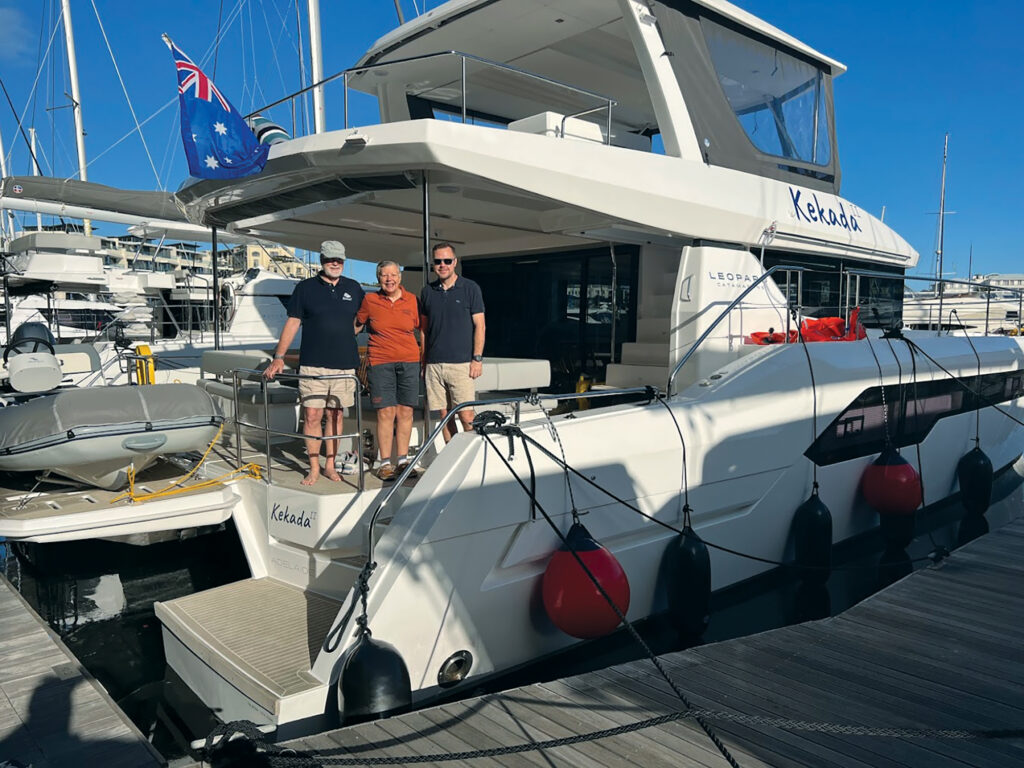
Keith Richards had ambitions when he purchased his 53-foot powercat, Kekada. He wanted to cruise the Caribbean and Mediterranean. He just had to get Kekada across the Atlantic Ocean first.
His Leopard 53 PC was built in Cape Town, South Africa, by Robertson and Caine, a global powerhouse that ships boats worldwide. It seemed to Keith that moving the boat on its own bottom would be a practical, cost-saving choice. He was also inspired by his parents, Don and Anja Richards, who had taken him and his sister, Katherine, across the world on a Catalina 42 Mk II back in 1998, when Keith was 13.
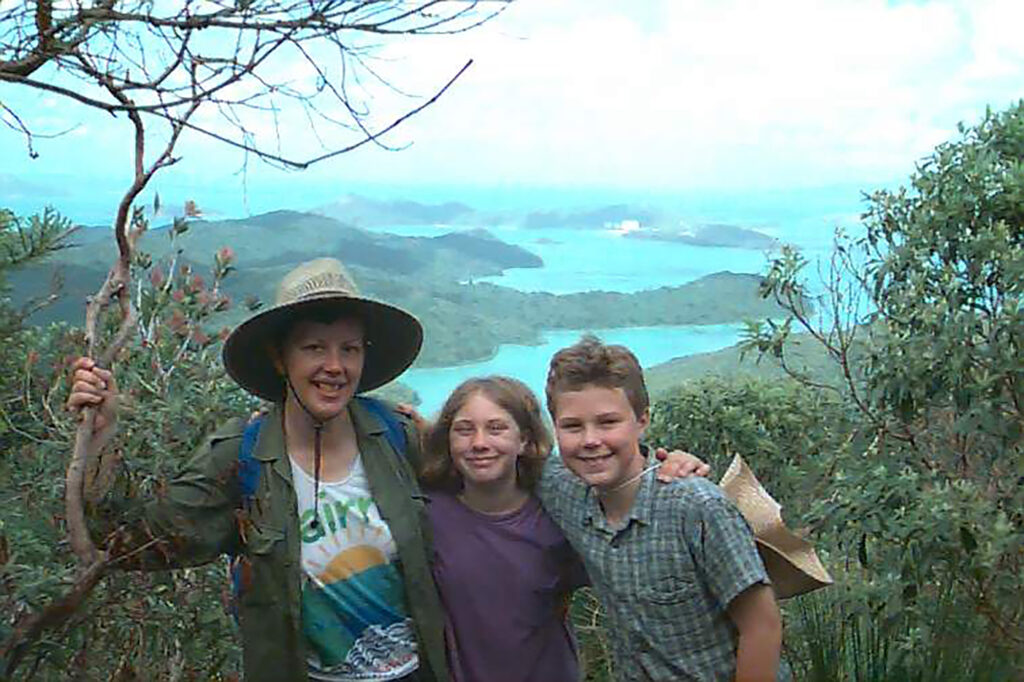
“I got two years off of school, went from Australia to Turkey, and then my parents took another two years to finish it off,” Keith says. “That made the idea of crossing oceans seem like a normal thing to do.”
The family had made their way west, slingshotting through the Bass Strait and up Australia’s east coast before heading to Indonesia, Singapore, Malaysia and Thailand. The Richards family then crossed over to Sri Lanka and the Maldives. They sailed to Yemen, up the Red Sea and into the Mediterranean, stopping in Turkey. The family had planned to end the cruise in the Mediterranean, but Don and Anja hadn’t yet had their fill. They completed their westward circumnavigation, via the Panama Canal, in 2003.
“I honestly don’t understand how they can be so relaxed, especially my dad,” Keith recalls. “Even as a kid, I’d worry about many things that he just seemed fine with, or that I now reflect on and think how brave they were to just explore and visit new ports in foreign places.”
The memory still lingered in 2022, when Keith pondered what to name his boat. Kekada, he says, is a reference to other experiences from his youth. In Hindi, the name means “crab,” a callback to an old four-wheel-drive vehicle nicknamed “Mudcrab.” The boat’s name also pays tribute to the four original family cruisers: “KE” for Keith, “KA” for Katherine, “D” for Don, and “A” for Anja. Keith credits his mom with the creativity.
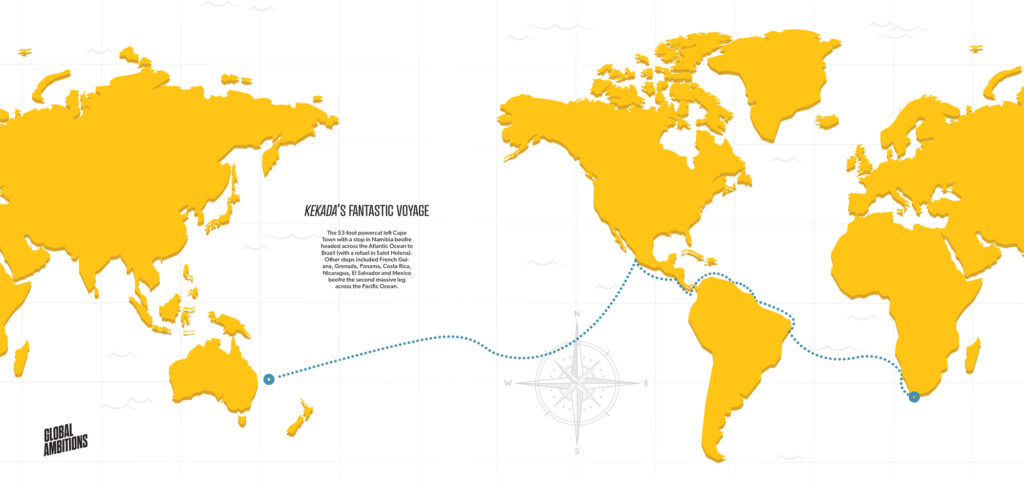
When Keith called his parents about cruising Kekada from the Leopard factory in South Africa to the Caribbean, Don immediately started to estimate the fuel range. Upon arrival in Cape Town, they confirmed Don’s calculations with test runs. While the catamaran has an advertised maximum speed of 24 knots and a suggested cruising speed of 17 knots, Don and Keith determined that motoring at 5 knots, Kekada would burn less than half a gallon per nautical mile. The standard Leopard 53 PC has more than 560 gallons of fuel capacity, so they installed two auxiliary fuel tanks to bump the cruising range to 2,750 nautical miles.
“Initially, we did a couple of test trips with the boat from Cape Town to Saldanha Bay,” Keith says. “The thing that surprised me most from cruising down there was the number of whales.” They saw pods of Bryde’s whales and, maybe, some southern right whales. “There were hundreds. It scared me at first because they would just pop up near the boat. If we had needed to avoid them, it would have been a crazy zigzag path with adjustments every few minutes, but thankfully, they always went under or around the boat, and slowly I began to relax more and trust it was going to be fine.”
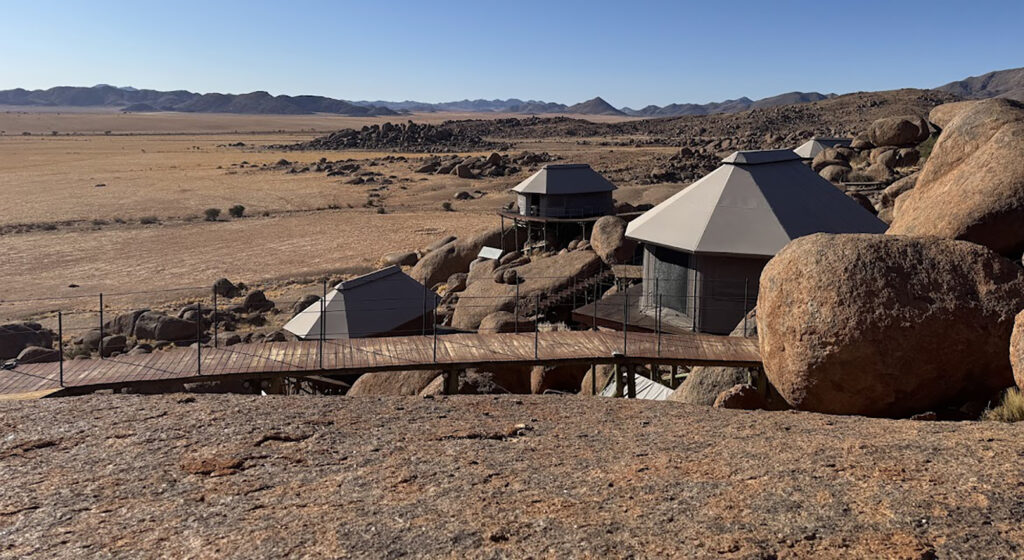
Then it came time for the first big leg of the trip: to Walvis Bay, about halfway up the coast of Namibia, roughly 800 miles by sea from Cape Town. Don, Anja and Keith completed that proof of concept without a hitch, and with only one disappointment. “As soon as we got near to Namibia, I was on the lookout for big sand dunes,” Keith says. “I was really hoping to see some like the ones found on the Skeleton Coast.”
Namibia’s northern coastline is famous for massive dunes that plunge into the water, but fog blankets the area, on average, 180 days per year. Even when the weather is clear, there is no guarantee the shifting dunes will be visible from the ocean. Keith vows to be back another time.
Keith then left Kekada in the care of his parents for a while and headed home to Australia to tend to various things. Don and Anja brought her across the South Atlantic Ocean. They refueled at Saint Helena, an island midway between Africa and South America best known for Napoleon Bonaparte’s final exile. From there, they completed the remaining 1,800 nm to Recife, Brazil. Kekada made that run with fuel to spare.
From there, Don and Anja cruised up the coast of Brazil to Fortaleza, and then on to French Guiana before arriving at Grenada. With hurricane season looming, Kekeda squeaked over to Panama for safety. Don and Anja had the cat pulled out of the water in Shelter Bay Marina, tantalizingly close to the mouth of the Panama Canal and the Pacific waters beyond.
Back home in Australia, Keith was finding travel logistics back to the boat more difficult than expected. The original plan was to spend some time in the Caribbean, and then base in the United States for a west-to-east Atlantic crossing to the Mediterranean—but from Panama, a new idea began to percolate.
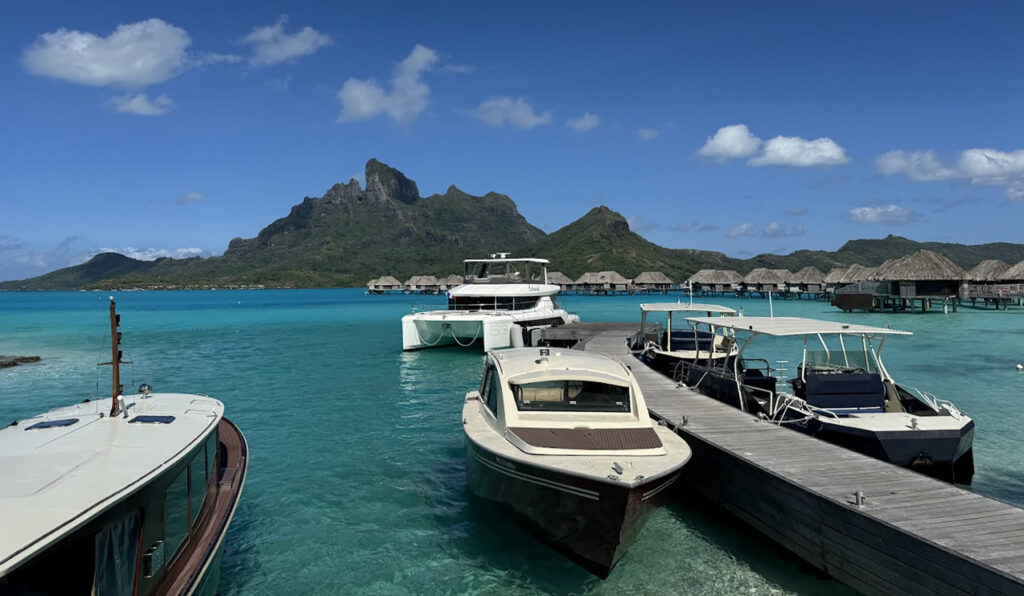
“While it was sitting out of the water, I was flipping the coin between ‘head to Miami’ or ‘head up to Mexico,’” Keith says. In the end, the answer was neither. He decided to bring Kekada to Australia.
Keith proposed the Pacific Ocean crossing to his parents, who had not visited the Central American countries and wanted to go. After transiting the Panama Canal, Don and Anja cruised north, hopping from Costa Rica to Nicaragua. Don highlights El Salvador as his favorite locale of the trip. The couple arrived in Puerto Vallarta, Mexico, positioning the boat for the 3,000-nm passage to French Polynesia. It would be Kekada’s longest crossing to date.
Keith once again had to add more fuel capacity, this time with flexible bladders that increased the comfortable cruising range to 4,500 nm. By this point, Don and Anja had distance down to a science, from maintenance to their watch schedule. Overnight, they would settle in for a six-hour shift apiece and supplement their sleep with naps throughout the day. Beyond that, they took care of normal household functions and routine maintenance around the boat, with plenty of time for reading.
“At sea they are bookworms,” Keith says. “Just quiet and to themselves, and I’ll always see them with a book nearby. My mum is very creative and artsy, so she might be knitting a gift for someone at a future port she hasn’t even met yet. She’s like that.”
Cruising a powercat simplified things from the family’s old sailboat: no need to steer to a shifting breeze or go on deck to adjust sails. With steady speed and a rhumbline course, timing the transit was predictable too.
Kekada cruised the marathon leg to French Polynesia with only a few mishaps, including an engine failure—although not until after leaving Samoa. En route to Wallis Island, one of the engines shut down. The culprit was contaminated diesel from Mexico. It took more than four hours to diagnose the problem and clean the tanks. That, plus reducing speed to 2 knots to minimize overheating, got them going again.
Keith was reunited with Kekada in Tahiti, where he brought along his partner and friends. The beamy powercat was a nice lifestyle upgrade compared to the monohull sailboat. “Now I’ve got a nice flower vase and wine decanter and stuff on display, and I don’t really need to stick anything down,” Keith says. “It all just stays there. It’s amazing.”
With more recent ports of call in Fiji and New Caledonia, Kekada is now in New Zealand, where Keith had a generator installed to supplement the solar panels. He plans to bring the boat to Australia so he can share the powercat experience with more friends and family. There’s still one member of the original Richardson family trip who needs a turn: his sister Katherine.
Keith says his final destination is yet to be determined. Maybe Perth in Australia, the Seychelles or back to Cape Town. The Bahamas and the Mediterranean also come up. He adds: “I really hope I’m building up good karma somewhere and will make it work.”
This article originally appeared in the September 2025 issue of Passagemaker magazine.