


The nearly full moon was almost as bright yellow as the sun where it set over the Olympic Mountains across the Strait of Juan de Fuca to the south. We casted off, ventured south and cleared Victoria Harbor, at which point the 17-boat Aspen Power Catamarans armada turned west-northwest, toward the open Pacific.
Our ultimate destination was Nootka Sound and all points of interest in between along the sparsely populated, wild west coast of Vancouver Island. Chatter on the VHF radio was minimal with skippers sleepily sipping their coffees, a slight apprehension in the air.
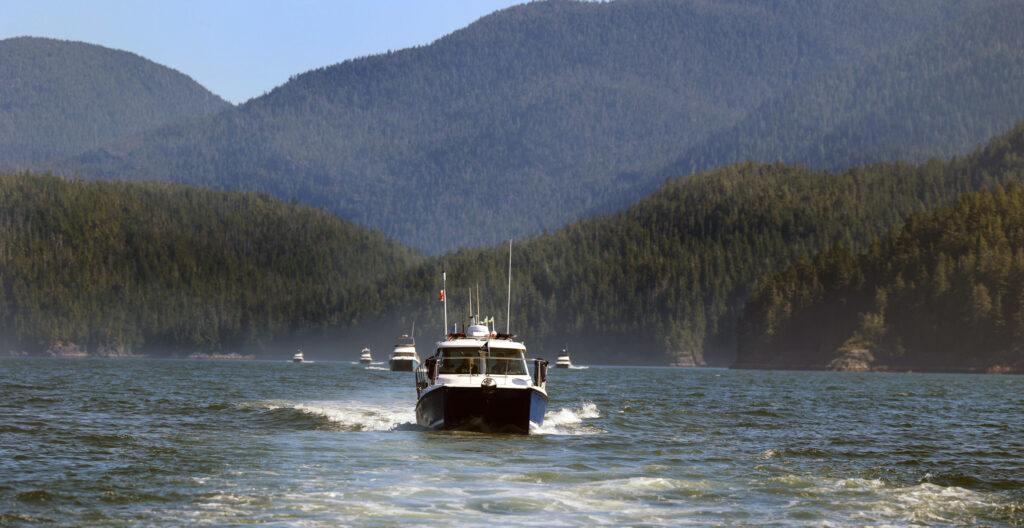
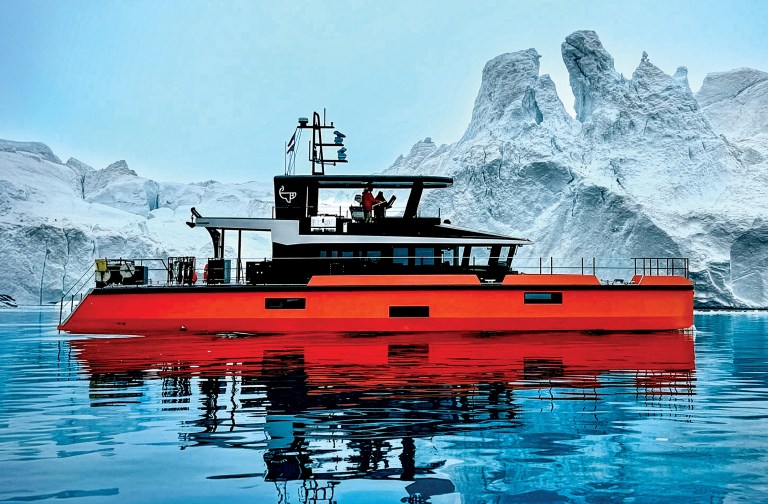
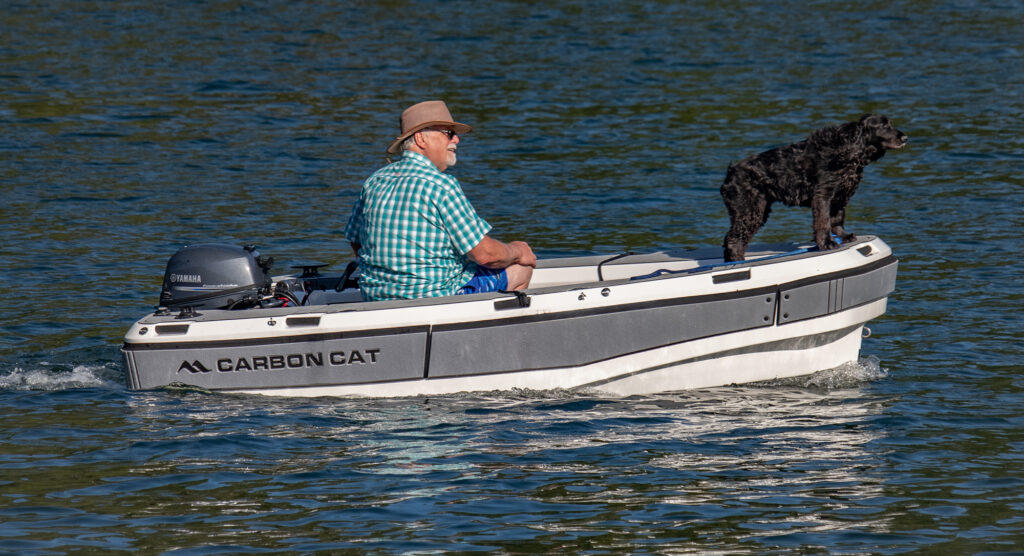
I was aboard the boat owned by Larry Graf, founder and owner of Aspen. Also aboard the C100 Cat Man Do was his loyal pup, a black field spaniel named Daisy. She took her place at my side by the copilot seat. Nearby, Hull No. 1 of the new flagship, the 44-foot C128 Susie Q, cruised with owners David and Susie Gatling at the helm. They’d been handed the keys the day before in Anacortes, Wash.
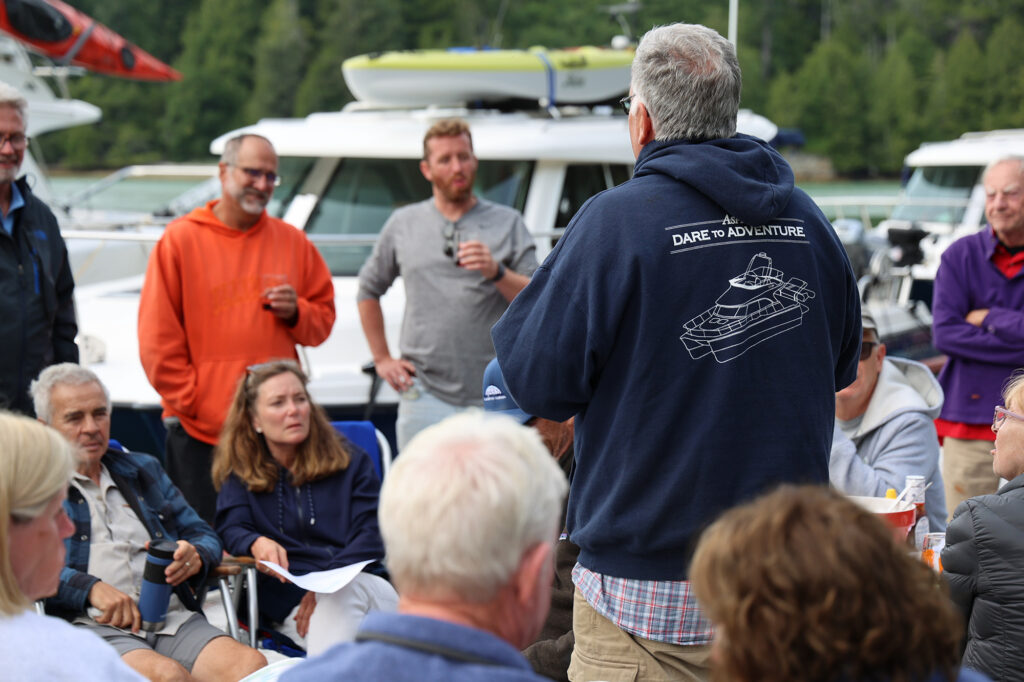
For the Gatlings, this voyage was the ultimate shakedown. Graf had suggested the west side of Vancouver Island concept to the whole owners’ group about a year earlier. He’d been surprised, and not-so-secretly excited, by the response. “I thought it was going to be five or six boats, maybe seven,” Graf says, laughing. “We ended up with 17.”
He gave them all a 45-minute presentation about the realities of such a cruise: possible big seas, rustic days on the hook, remote locations. The 17 stood firm, and off we all went. We’re actually doing this. The excited nerves of the fleet radiated across the velvet purple dawn.
Vancouver Island, at 12,000 square miles, is three times larger than the big island of Hawaii. Its landscape is home to deep-cut inlets, rugged rocky coastlines and mountains over 7,000 feet tall. The island protects a stretch of the Inside Passage from Puget Sound to Queen Charlotte Sound from open exposure to the Pacific Ocean. Vancouver Island’s east coast is part of what makes the Inside Passage a boating delight. The west side is a different story.
“No other boat company has ever done this because it’s 80, 90 miles of open ocean to get to Barkley Sound” from the Strait of Juan de Fuca, Graf says. Personally, I hadn’t heard of a boat company doing something this ambitious with its owner-operators.
The only land west of this stretch of North America is Japan, a fetch of over 4,000 nautical miles. That openness creates an ideal runway for wave energy and building storm systems. The Kuroshio Current from Asia flows uninterrupted. It tends to break and swirl against these shores. Approaching from the south, as we were, generally means going against the prevailing currents and winds as an uphill run. The first stretch from Victoria to Barkley Sound can be a sweet dream or nightmare depending on the conditions. Aside from Port Renfrew, 53 nautical miles from the starting point, there’s nowhere to hide.
The mountains play their mischief as well, feeding localized wind systems that can rip toward or away from land, depending on the season or time of day. Settlements, and even road access, is scarce amid the forests and rock faces. Powerboaters need to triple check their fuel math. Weather windows are everything. Mistakes have real consequences.
However, the payoff is exquisite.
“Once those open stretches of open Pacific are conquered, a boater has unfettered access to southeast Alaska-like cruising grounds, with a tiny fraction of the crowds along the Inside Passage,” Graf says. This is a land of quiet, uninhabited islands thick with bears stalking salmon, ripe for anglers, and endless dinghy or kayak exploring.
“It’s totally wilderness,” he adds. “It’s kind of like Alaska, but it’s only 150 miles from, you know, Anacortes. So it’s close wilderness that no one goes to because they’re fearful of doing the open ocean.”
Our trip included Barkley Sound, Clayoquot Sound and Nootka Sound, separated from one another by exposed waters and headlands. Thumbing through a guidebook here is similar to poring over a map of Middle Earth in The Lord of the Rings. Barkley Sound contains the Broken Group, a series of pristine islands protected under Canada’s national park system. Clayoquot Sound’s Hot Springs Cove has thermal baths. Nootka Sound was a landing spot of the explorer Capt. James Cook and the island’s namesake, Capt. George Vancouver. Bligh Island is named after the captain of HMS Bounty of mutiny fame.
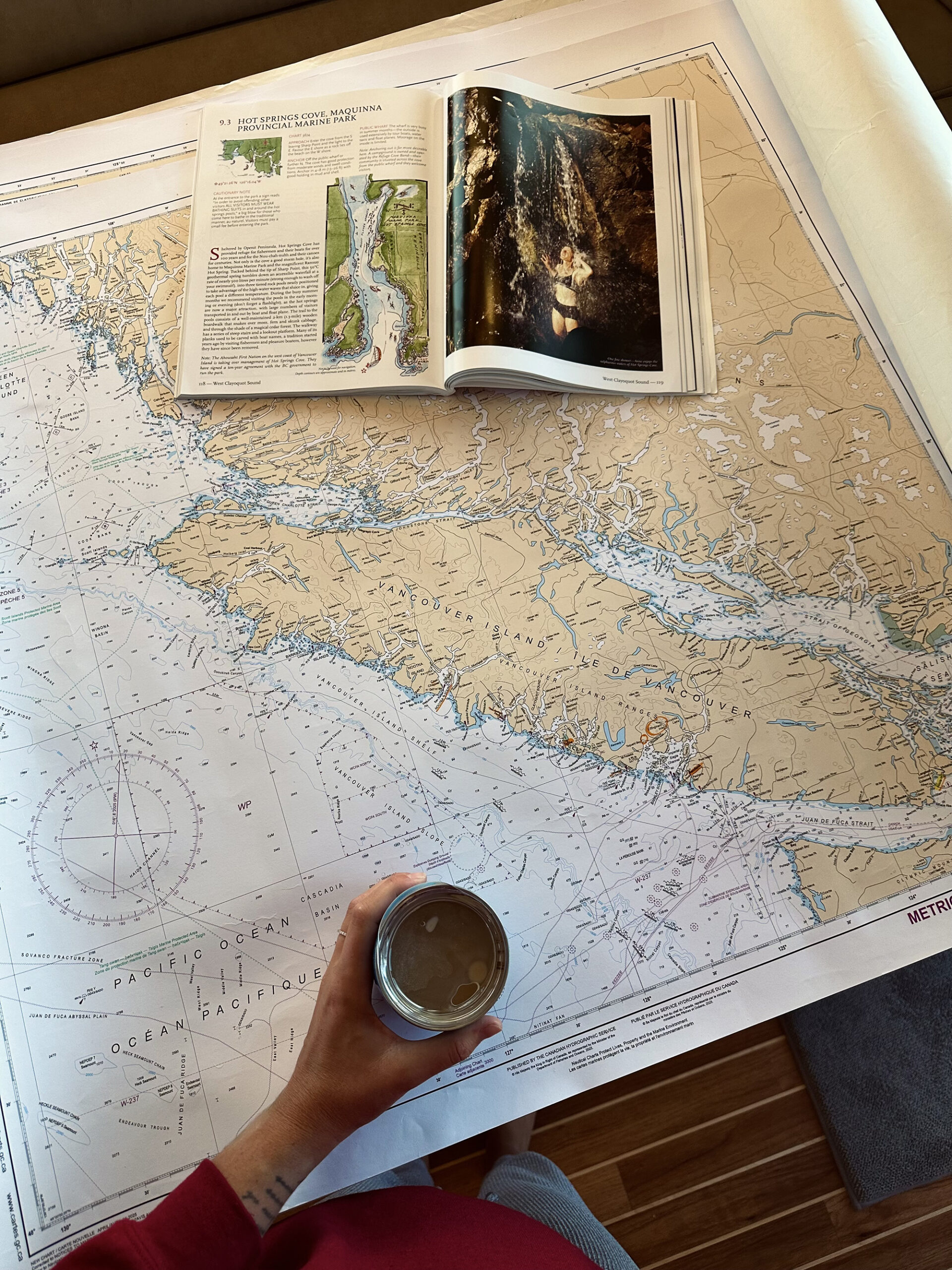
Uphill to Barkley Sound
Our initial 100-nm run from Victoria to Barkley Sound is neither sweet dream nor nightmare, but perhaps something of a fever dream. We found ourselves in 4- to 6-foot swells and mildly confused seas before entering dense fog for the rest of the day, with only a few hundred feet of visibility.
“Guy in a small crabbing boat up ahead here,” an Aspen owner said over the VHF radio. “Had to dodge him in this fog. Keep an eye out.”
Cat Man Do performed admirably, generally cruising in a 17- to 19-knot sweet spot and riding well. Aspens are suited for this kind of adventure, thanks to their fuel economy and relatively fast cruising speeds. That speed is especially useful for making the open-ocean stretches a morning affair instead of an all-day slog. At those speeds, Aspen promotes a theoretical range of more than 200 nm with the standard 80-gallon fuel tank for the C100.
After the open-ocean run, we took a north-northwest turn past Cape Beale and into Barkley Sound. We ended up at the Port Alberni Yacht Club outstation. The yacht club members have floating docks and showers, and they rent out spare space. They treated us with classic Canadian friendliness, tending lines and talking weather.
The Aspen armada, meanwhile, organized into a potluck on the docks. Everyone was in one piece; a handful of cruisers had left their half-digested breakfasts in the rougher waters, but laughter dominated the gathering. Graf happily drifted from boat to boat with his toolbox, addressing the inevitable odd jobs. He took care of a water-pump issue in six minutes with a fuse replacement and the retirement of an old pump. All Aspens have two water pumps and two water tanks for redundancy, so the owner would run the good pump for the rest of the trip.
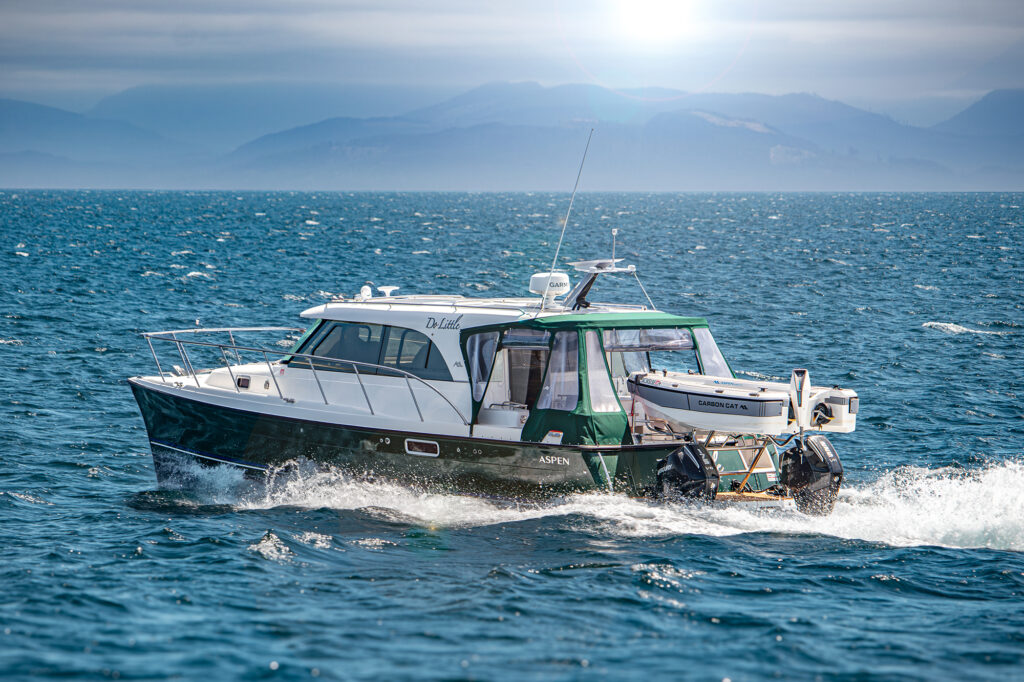
“Seeing all those people on the dock having a potluck dinner, having fun, I mean, that’s what I do,” Graf says. “I build boats for people to have fun. These people have worked really hard their whole lives to have the resources to buy a toy like this. It’s a toy. We’re all big kids buying toys. And they desire a toy that works and is capable.”
To Clayoquot Sound and Hot Springs
Barkley Sound was our playground for the next few days, with a night spent on the hook in the Broken Group and another in Ucluelet, which the locals call “Ukee.” Much of the town is hotels that support summer tourism, notably salmon fishing. We docked at 52 Steps, a dock that has, you guessed it, 52 steps up a bank to Otter Street. We loaded up on groceries at the Ucluelet Co-Op General Store, I hit up the Mr. Sparkolo Laundromat, and a few rounds were enjoyed at the Ucluelet Brewing Company.
Half the town’s population appears to be college kids from bigger cities holding down summer jobs. The laundromat is the first one I’ve ever been to where the soaps are free (a note with smiley face asking to just take one). The grocery store, and most of Canada, is militant about the policy of leaving backpacks at the door in an unguarded pile with the others.
I don’t recommend doing that in Seattle.
A major part of life for boaters here is cross-referencing weather reports from the VHF radio and apps like Windy and PredictWind. A nasty gale was dancing around offshore, flirting with us. Ultimately, a window opened and we headed to Clayoquot. The mostly open-ocean jaunt across about 40 miles would take us past great surfing beaches. We had to contend with significant swells of 10 feet, but the winds were low. Until late in the morning, that is.
VHF radio chatter was lively. Graf calmly offered tips: Quarter those incoming big ones. Stay away from the near-shore shallows. Don’t go too wide to add unnecessary miles. The transit reminded me a bit of climbing Mount Rainier, requiring planning, commitment and situational awareness.
The sun broke, illuminating vast golden beaches on shore. Aspens were practically leaping over the wave crests. Boats behind us disappeared into the troughs, with only their flybridges poking above the blue. All embraced being an aquatic version of an offroad rally.
The sun brought whitecap winds just as morning slipped away and that flirty gale was about to make a move on us. Daisy transitioned from her seat onto my lap and, ultimately, moved under the galley table into a nest. We turned inland between Tofino and Vargas Island, and ducked into the long, protected waterways of Clayoquot Sound.
The contrast with the open water was stark as we navigated the narrow channels westward. Zero settlement. No roads. No marinas. No towns. Barely any boats. Just deep green water winding through forested rock.
Hot Springs Cove was our main destination for the day. We passed dozens of sea otters en route. We paid $10 CAD per person at a First Nations-
operated dock. Aspen owners in swimsuits peeled off into the forest for the 2-mile hike to the springs and back. Towering redwood groves and big-leafed skunk cabbage patches enveloped the boardwalk trail. The forest walk was a zen cleanse, and the springs had a waterfall along with a wood shelter with changing rooms.
The springs start hot and sulfurous, then cool farther toward the sea. Water shoes are recommended for the slippery bits.
For the night, we ventured deep into the sound up Holmes Inlet. The armada spread out among the anchorages. Cat Man Domoored in Bottleneck Cove. We were between the lee of an island and oyster-
encrusted tidal rocks. When we woke to a misty morning, a large black bear was feasting on the oysters.
Good taste, I thought as I watched it forage.
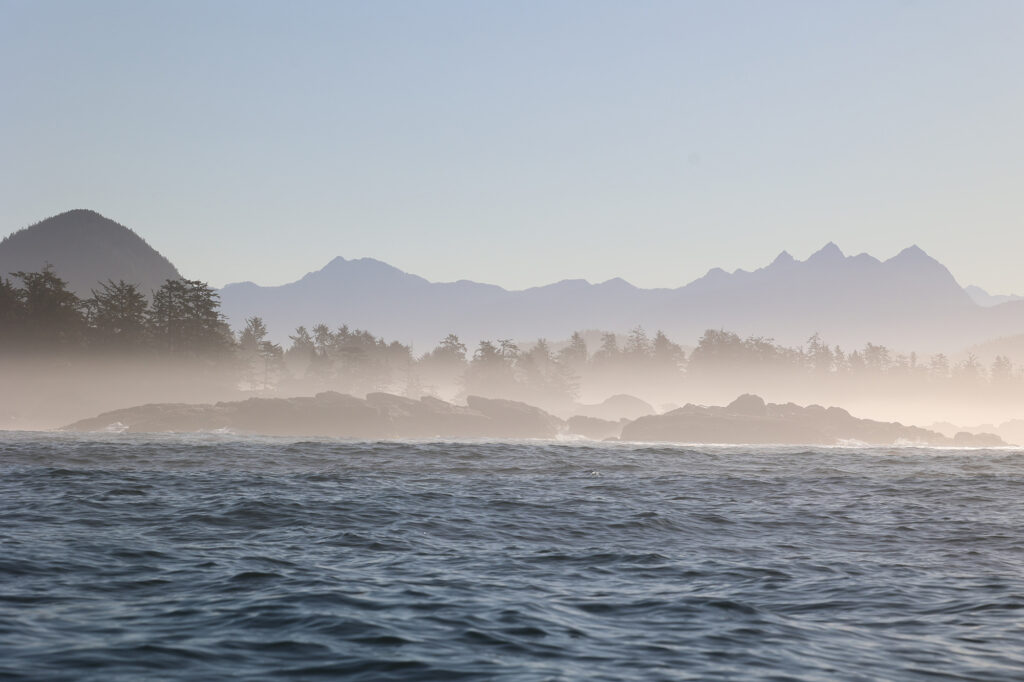
Nootka or Bust
Our final northward push was to Nootka Sound, about 20 nm, but out and around the daunting Estevan Point. Another morning bash was in store. About half the boats opted to stay behind and explore Clayoquot properly. One could spend all summer bopping around the waterfalls, coves, islands and more.
The eight or so boats that headed north to Nootka had an experience similar to the open-ocean stretch, except perhaps windier. Every 20 seconds or so, a 10-footer made itself known. But the gale was going to stay onshore starting that afternoon.
One boater’s engine stopped working, leaving him down to one.
“It’s probably kelp in the intake,” Graf said over the VHF radio. He was right.
At last, we reached Nootka’s Friendly Cove. Once again, the calm felt surreal. We docked, paid the First Nations representative $10 CAD, and set off to explore this onetime setting for an important peace agreement between the empires of Britain and Spain. The picturesque little cove isn’t much today, but its legacy of bringing different people together endures.
Once the open stretches of open Pacific are conquered, a boater has unfettered access to southeast Alaska-like cruising grounds, with a tiny fraction of the crowds along the Inside Passage
Two structures overlook the cove: the wood carver shop of Sanford Williams, and the Nootka Lighthouse. Williams, a master Yuquot totem carver, welcomed us into his shop. His newest work was far along, laying horizontally.
“What’s this?” I said as I pointed to the face at the base.
“Wolf,” he said. “For protection.”
His said his latest creation was a commission, bound for a hotel. He also held up a large object that looked like a massive fang. “Can you guess what this is?”
Whale tooth? Bear claw?
“It’s a really weird piece of wood,” he said with a laugh.
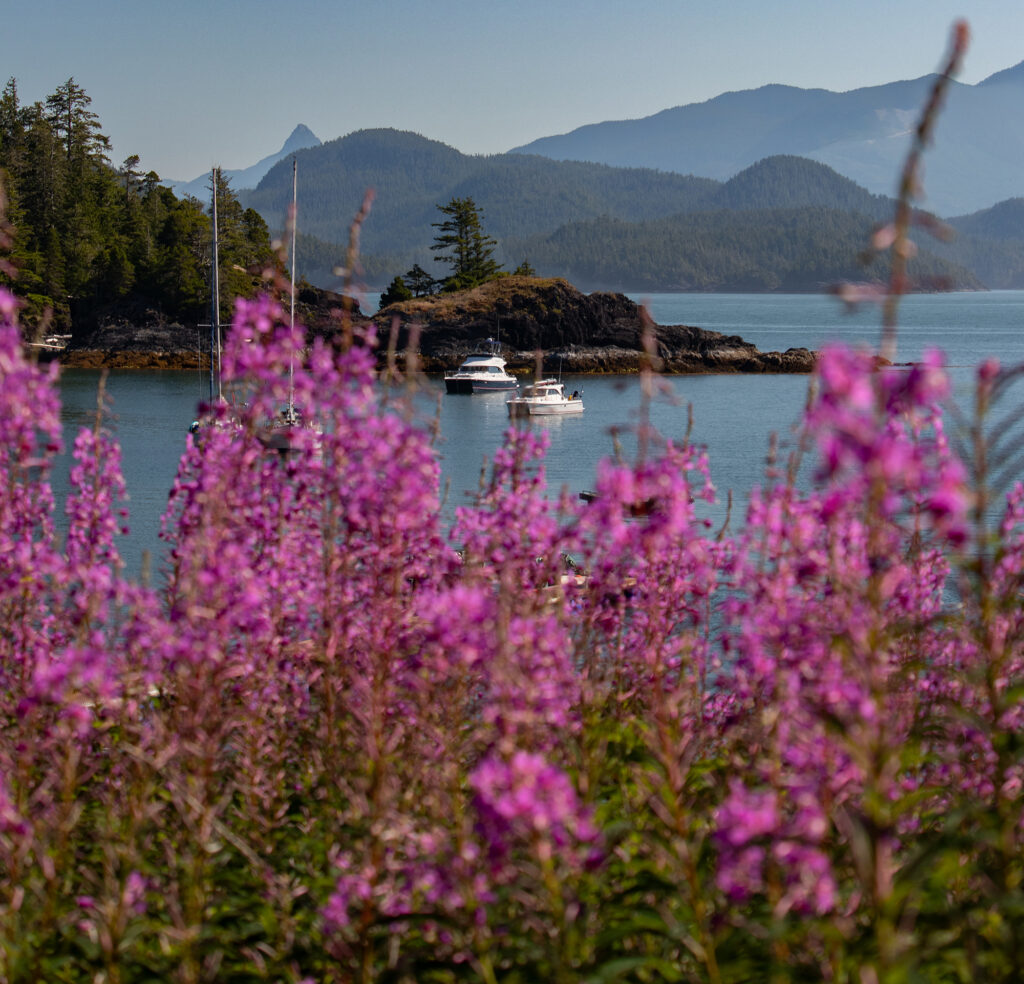
Out back behind the shop was a fallen totem. They’re supposed to age naturally and fall like the trees from which they are carved. They are meant to return to the earth. This particular fallen totem was amid the purple blooming fireweed, with ferns growing from the carved animal faces and chests.
We ventured up to the lighthouse, which was closed, but a middle-aged man waved us past the sign. “C’mon in folks! I’m painting the fence. You’re just in time to do it for me,” he said.
He was the retired Canadian coast guardsman who serves as lightkeeper. The view was stunning as we looked outward to the open ocean we had just cruised across.
We stayed that night at Westview Marina in Tahsis, which has a Parrothead-themed dockside bar called Margaritaville North. It’s right near the fish-cleaning tables and fresh salmon, lingcod and halibut. “There’s an otter under there going after fish guts,” the hostess explained.
Bald eagles were as thick as crows, hitting the leftovers at the cleaning tables too. The Aspen owners ordered pitchers of margaritas to share.
We’d be pinned down in Nootka Sound for a few days as the gale set in. Nobody complained.
In my Tahsis margarita-fueled mind, I muse on why the west side of Vancouver Island ultimately entices the imagination. The same dream that seduced the Aspen armada likely motivated Captains Cook and Vancouver and inspires Williams. Green waters, sulfur hot spring water and oyster-eating bears. Perpetual flirtations with gales. Often sweet, sometimes scary, and occasionally fevered, the wild west side is a dream nonetheless.
This article originally appeared in the November/December 2025 issue of Passagemaker magazine.