

When a yacht like Croix du Sud appears on the market, people often see her as a relic. She was built in 1944 in the U.K. as a torpedo boat, and was later refitted for recreational use. Those in the know would recall her striking presence on Dutch inland waters for decades.
Recently, she was listed for sale at De Valk Yacht Brokers, and I saw something else: a blank canvas awaiting a modern update.
As a naval architect, designer and from a boating family, I’ve always been fascinated by vessels that are structurally sound but feel stuck in an identity that doesn’t quite match the way people live or travel today. That is where my firm SIEdes began—as a design studio with a goal to help people see what their older boat could become.
We focus on yachts from 50 to 95 feet long that are still owner-operated, with all the charm and responsibility that relationship brings. In this size range, a good refit can make the difference between a boat that sits unsold for years and one that’s passed on proudly to the next chapter.
So, when Croix du Sud came on our radar, we didn’t just see teak and hull lines. We saw possibilities. And we decided to explore them, to help the current owner, the broker and, perhaps most important, a future buyer.
Every refit starts with questions. Is this boat worth saving? Can we adapt her to a new lifestyle? How far do we go? Is it worth the expense?
Too often, the answers to those questions remain vague. The result is a boat that stays on the market, or a refit that drifts without direction. A design study doesn’t answer everything, but if done well, it creates a spark. It brings shape to a conversation that otherwise happens in guesses and sketches on napkins.
Our design process is structured and light-touch. The investment for this type of proposal can be a strategic alternative to the kinds of price reductions that often occur in the sales process. A compelling design vision may cost a fraction of what a seller might otherwise concede on asking price. That’s the gap we aim to close, with design rather than discounting.
On Croix du Sud, we began with a 3D scan and a technical walkthrough. Using a high-resolution lidar scanner, we quickly captured the vessel’s full geometry, inside and out. Within hours, we had a detailed, accurate digital base model to begin designing on. Every angle, bulkhead, deck line and doorway became measurable and traceable. We measured volumes, flow, headroom and structure. We noted charm and areas in need of improvement.
From there, we developed three style directions, not as finished products, but as moods: Hollywood Chic, defined by a warm, cinematic look with metallics; Dolce Vita d’Amsterdam, which is open and light with a playful motif; and Baltic Reverie, a minimal, robust and tactile approach.
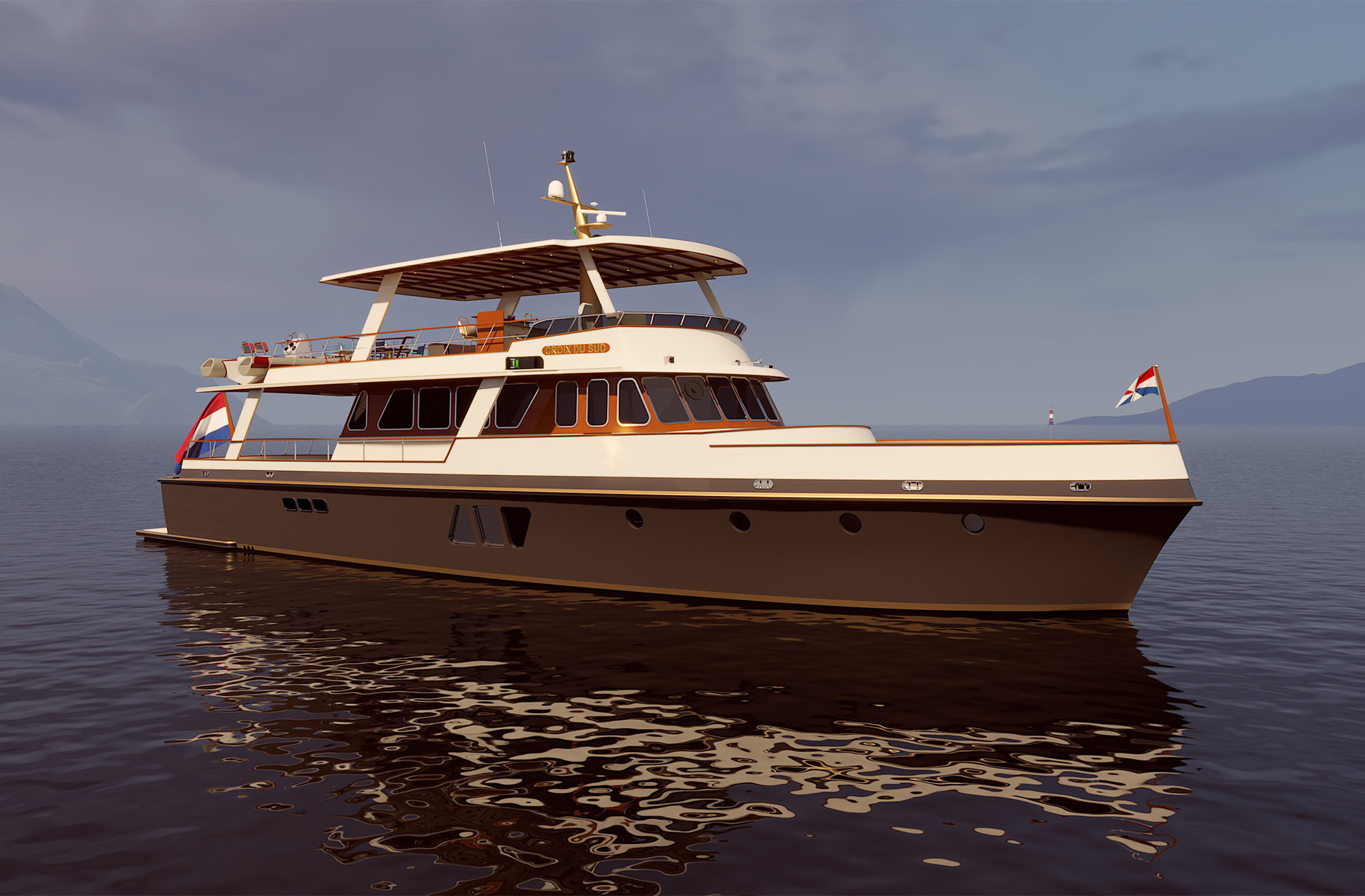
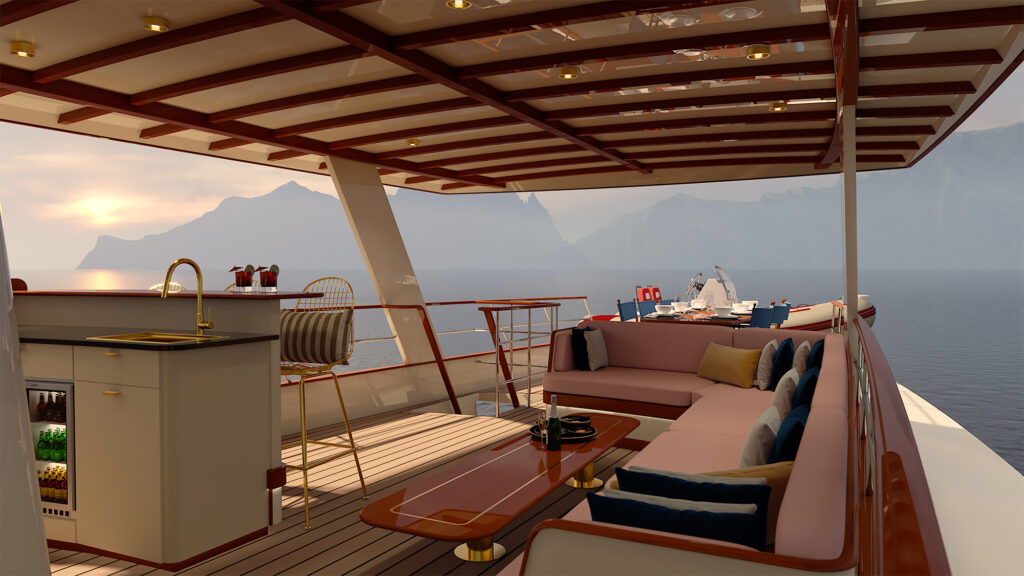
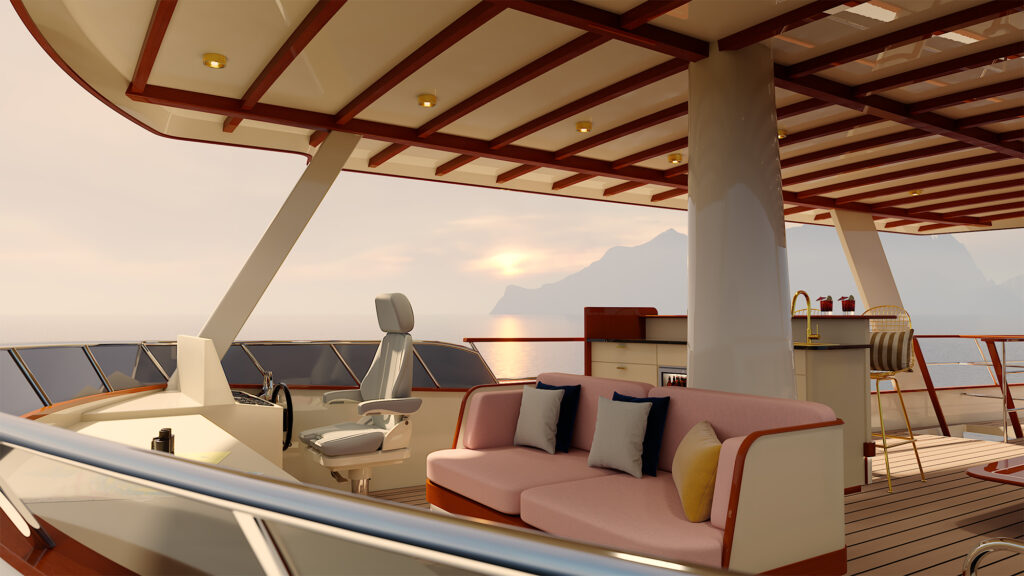
After sketching out layout options and possible exterior updates, we reviewed the concepts with the current owner. We agreed on Hollywood Chic as the path to develop further. We created teaser visuals, just enough to open the conversation. The flybridge was rendered with a bar and hardtop. The hull would be Awlgrip’s macadamia brown metallic. The canopy was extended.
Some other suggestions included a tender garage below the crew cabin, and a hot tub built into the aft deck with a wine bar just forward, under the stairs that lead to the flybridge.
We’re now waiting for the next owner to step in, respond and refine. Once that happens, the real layout and engineering work can begin. Depending on the direction, we can quote light makeovers or deep transformations, with different budgets, time frames and partners. We can engineer systems, renew insulation, integrate technological solutions or preserve just enough patina.
This process isn’t just about one yacht. It’s about what happens when you take something solid, something proven, and allow it to become relevant again. Many boats still have great years ahead of them, not just as floating nostalgia, but as companions for new adventures. They don’t always need a full rebuild. Sometimes, they just need a clear idea and some insight for a way forward.
In the end, refitting isn’t about reviving the past. It’s about giving shape to the future.
Croix du Sud Specifications:
LOA: 77ft. 6in.
Beam: 20ft. 7in.
Draft: 5ft. 1in.
Displacement: 114,640 lbs.
Fuel: 1,374 gal.
Water: 290 gal.
Engines: 2x 525-hp Detroit Diesel 12V.71N
This article originally appeared in the October 2025 issue of Passagemaker magazine.