Trawlerfest is one of my favorite events during the year. I gain insights for managing Tiramisu, my Nordic Tug 42. I have engaging conversations with all levels of boaters, listen to outstanding presentations by industry experts, and stroll the docks boarding luxurious boats.
This year in Anacortes, Wash., I attended “Ask the Experts: Town Hall.” I could not resist asking each of the panelists to share a medical episode that was their worst experience. The responses were stories best summarized by Mark Twain, who wrote, “Seasickness: At first you are so sick you are afraid you will die, and then you are so sick you are afraid you won’t die.”
Why Do We Get Seasick?
Seasickness is a motion-induced conflict between what our body’s balance system expects and what it actually experiences. Our bodies determine motion and orientation through three major inputs. The inner ear vestibular system—the semicircular canals and otolith organs in the inner ear—detect rolling, pitching, yawing, acceleration and gravity. Combined with our eyes and the body’s muscles and joints, our brains perceive whether we are moving or stable, and how our body is positioned.
Our inner ear feels constant rolling and vertical acceleration, yet our eyes, oriented to the cabin sole or ceiling, see a stationary object. Our brain receives conflicting information. “We are moving” and “no, we’re not moving” are interpreted as abnormal neurologic activity, triggering protective responses, especially nausea and vomiting.
Mariners will recognize the cold sweats and gray-face stage before vomiting begins. But it is best to be aware of earlier stages, to mitigate the problem before it’s too late.
The first stage is fatigue. Drowsiness often comes with a headache and reduced concentration. Cold sweating, dizziness and nausea follow. The last stage is debilitating retching and vomiting, and an immediate need to rehyrdrate.
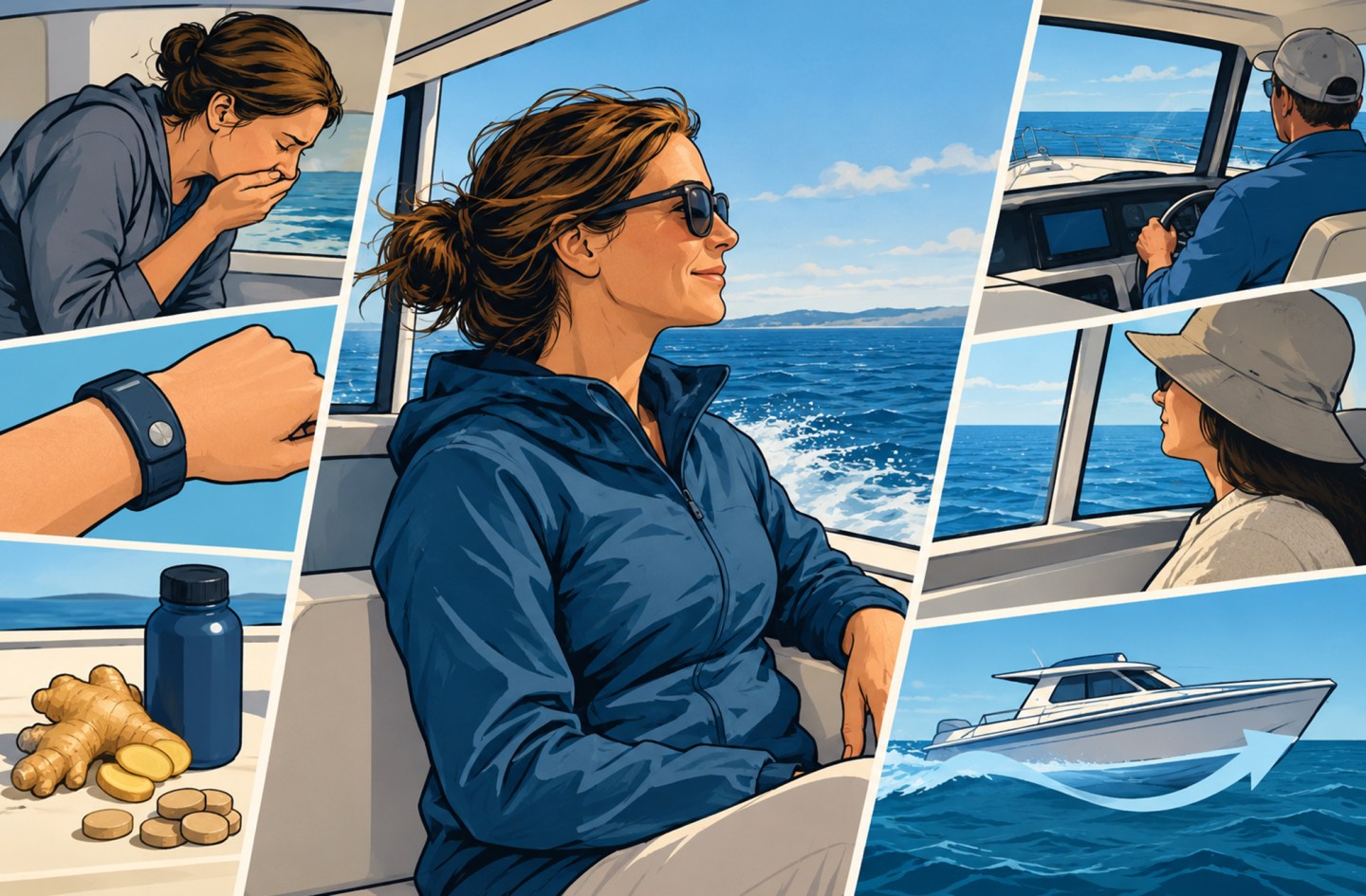
Experienced mariners will say to get outside, watch the horizon or stay amidships, advice that is physiologically correct. By gazing upon the horizon, our eyes obtain a stable external reference that allows the visual system to synchronize with the vestibular system. Our eyes see the ship moving, our inner ear feels the ship moving, and the mismatch decreases.
Remain belowdecks, and the visual clues disappear. Ventilation and odors may be worse. Our inner ear senses motion, yet our eyes no longer confirm it, thus the mismatch increases dramatically.
Fatigue and anxiety make seasickness worse by lowering our brain’s ability to compensate for sensory conflict while anxiety amplifies nausea pathways. Poor sleep, dehydration, hangovers, heavy meals and fear all worsen seasickness.
Steering the vessel can also reduce seasickness because active control improves motion prediction. Our brain anticipates movement instead of reacting to it. Predicted motion causes less sensory conflict than unexpected motion. This is why passengers get seasick more often than crew.
Getting Your Sea Legs
Usually within 24 to 72 hours at sea, with repeated exposure, we regain operational capacity. Our brain recalibrates through vestibular adaptation. Our central nervous system learns these motion patterns are normal, and our autonomic nervous system kicks in to regulate processes that stabilize our heart rate, blood pressure, respiration, digestion and salivation.
It is best to avoid heavy work initially during first offshore watches, maintain sleep discipline, and hydrate aggressively, early.
Management of seasickness works best when approached in layers. Begin with preventing sensory conflict, reduce vestibular stimulation, suppress nausea pathways, maintain hydration and performance capability, and treat vomiting early before exhaustion develops.
Find the most comfortable onboard spot that works best for you. The most stable locations are midship, near the vessel’s center of gravity. Avoid locations at the bow with large vertical acceleration, the stern with pitch and yaw amplification, and confined interior spaces. Face forward, focus on fixed objects in the distance, and avoid reading and screen time.
What you eat can affect the outcome. Crackers, carbohydrates, bread, rice, bananas and soups are good choices, and small, frequent meals are preferred. Avoid an empty stomach, as gastric acid accumulates, promoting nausea. Greasy foods, alcohol, excessive caffeine, large meals or spicy foods can come back to haunt you.
Medication is an important part of managing seasickness. It is best to start taking it before symptoms begin, especially if you’re dispositioned to seasickness. Once vomiting begins, oral medications are less effective. Antihistamines will suppress vestibular signaling. For crew on watch or at the helm, brands like Zyrtec, Allegra and Claritin are recommended over Benadryl, which can cause drowsiness. Meclizine is also less sedating and longer acting as an alternative medication.
Scopolamine blocks transmission between the vestibular system and vomiting center via a transdermal patch behind the ear. Applied four to 12 hours prior to departure, the patches last approximately 72 hours. Scopace is an oral equivalent. Both medications require a physician’s prescription. While highly effective, they may cause dry mouth, urinary retention and blurred vision, and they may lead to impaired cognitive sharpness.
Zofran is effective for controlling vomiting, though it’s less effective for vestibular motion sickness than scopolamine or antihistamines. While it does not strongly suppress vestibular conflict, it does reduce vomiting, has minimal sedating properties and preserves cognition.
Treatment Once Vomiting Begins
The major risks with vomiting is loss of electrolytes, dehydration, exhaustion, impaired judgment and inability to safely stand watch. Immediately remove the mariner from provocative stimuli, and then bring them outside into airflow with their eyes toward the horizon. Reduce head motion by stabilizing the head and neck with the mariner in a semi-reclining position.
Monitor for early signs of dehydration, including dry mouth, rapid heart rate, dizziness, reduced urine output or dark-colored urine, and fatigue. Severe dehydration can cause seriously low blood pressure, confusion, inability to function and increased heat injury risk.
Oral Rehydration Therapy is a type of fluid replacement used to prevent, and then rapidly restore, fluids and electrolytes to treat dehydration. Drinking water (1 liter) is mixed with prepackaged powder that contains modest amounts of electrolytes (sodium, chloride and potassium) and small amounts of sugar. Avoid alcohol, excessive caffeine and sport drinks with heavy sugar loads.
Small sips of ORT are superior to large volumes. Provide 2 to 4 tablespoons, slowly as tolerated, every five to 10 minutes until vomiting has abated. Individuals with mild to moderate dehydration should slowly advance to a simple diet within six hours, and then a full diet within 24 to 48 hours.
If the mariner develops muscle weakness, a weak thready pulse or a change in mental status, the situation is dire and requires immediate evacuation to an advanced medical facility for intravenous fluids and intramuscular antiemetics.
While evidence is mixed, some mariners may benefit psychologically or symptomatically from acupressure bands or ginger. Ginger may modestly reduce nausea through gastric effects. It’s low risk, but usually not sufficient alone.
Even experienced mariners can become seasick under extreme sea states. Cognitive impairment may include slowed reaction time, poor navigation decision-making and decreased situational awareness—all especially dangerous during night watch or collision avoidance. With the first symptoms of seasickness, go on deck, look at the horizon, hydrate immediately and avoid isolation belowdecks. If vomiting starts, temporarily stop assignments, begin electrolyte replacement, use antiemetics, and carefully monitor mental status and urine output.
It is most important to remember that seasickness is not a sign of weakness, poor character or lack of toughness. It is a normal physiologic response of a healthy vestibular system exposed to unfamiliar motion. With proper preparation, early countermeasures, hydration, adequate sleep and time for vestibular adaptation, you will recover fully and will continue functioning safely and effectively while at sea.
This article originally appeared in the September 2026 issue of Passagemaker magazine.