

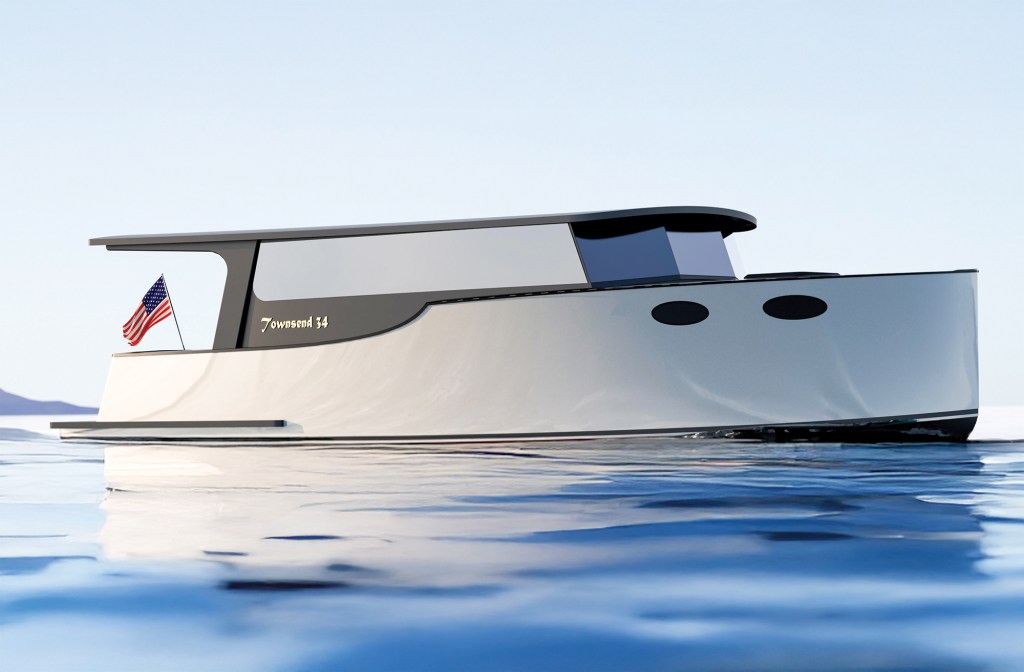
Tucked away at the back of a small shop in Port Townsend, Wash., a matte-black boat is beginning to take form on a mold. Her lines will be unmistakable to anyone who grew up in the Pacific Northwest and reveres the classic postwar beauty of the Lake Union Dreamboat. This contemporary interpretation of that form—the aptly named Townsend 34—signals its lineage clearly, even in its current unfinished state.
The Townsend 34 shares design cues with her predecessor: a gentle step up from the forward edge of the housetop toward the bow; a wood-laden interior; and a long, lightly cambered roof that overhangs the cockpit and tapers subtly toward the outboard edges.
But that is where the similarities end. Brandon Davis leads the small team of craftsmen on the shop floor, serving as a creative force in a town already dense with maritime professionals. He owns Turn Point Design, with a portfolio that ranges from fabricating components for America’s Cup campaigns to developing and selling kit boats and a foiling powercat.
Reinvention is a recurring theme. Along with Matt Mortensen and Chris Brignoli, the electronics and EV specialists behind ReVision Marine, Davis is pushing the project toward its next phase. The goal is to have the boat ready to take to the water this summer, with its first customer, investor and guiding mind—Alex Borton, with Solar Sal Boats—closely involved in the process.
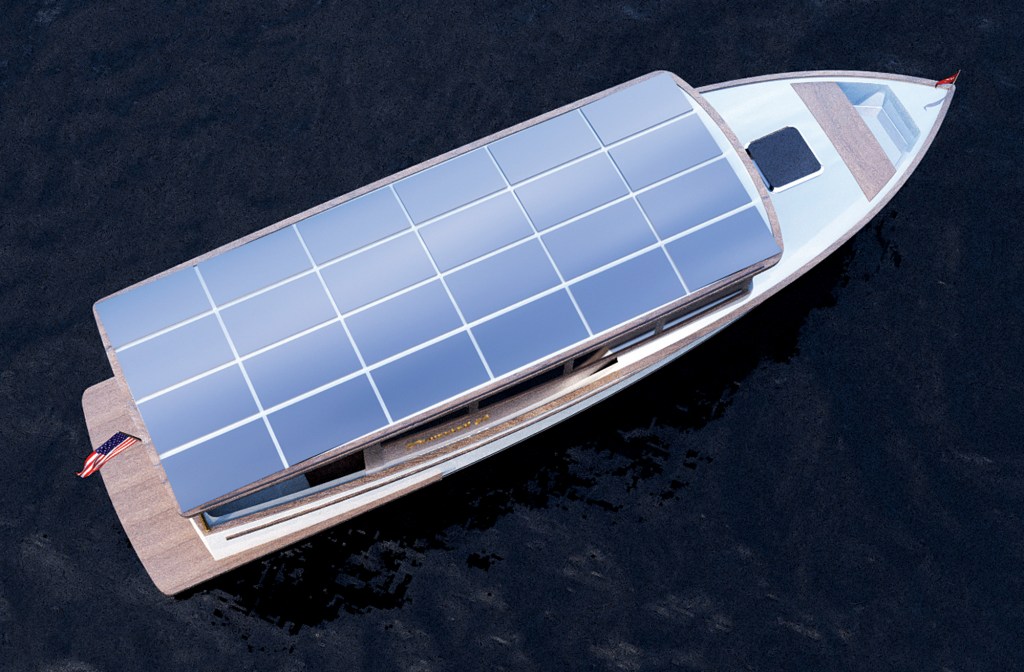
The T34’s distinctive roofline isn’t merely an aesthetic nod to the Dreamboat’s legacy. It is the working surface onto which 3,800 watts of solar panels will be affixed, supplying all the power this 34-footer will need for silent operation. If Davis and his team achieve their projected numbers, the resulting performance figures would be striking: a top speed of 12 knots and a cruise speed of roughly 7.5 knots, driven by a 24-kW Oceanvolt marine drive. While solar electric propulsion isn’t new in the cruising-boat world, the T34 can reasonably be described as an evolution of forward-thinking designs.
When finished and launched for sea trials this summer, the vessel should represent a noteworthy entrant into the custom cruising yacht market, and not only as an all-electric cruiser. She will also be built from environmentally friendly basalt fiber instead of fiberglass or stitch-and-glue plywood.
Why basalt? Simply put, when volcanic rock is heat-processed into a woven fabric, it is a similar laminate compared to fiberglass with up to a 20 percent greater tensile strength. It’s slightly denser and heavier than E-glass, but less material is required than with traditional fiberglass layup, resulting in a lighter, stronger overall structure. Basalt also provides chemical, thermal and UV resistance. It’s manufactured with one-tenth of the energy input demands of carbon fiber, and 20 percent less energy input as fiberglass.
Taken together, those characteristics led Davis and Borton to view basalt as a way to control costs while delivering the first hull with an efficient, durable and environmentally considered structure—so much so that projections over 20 years of ownership point to a production carbon footprint of zero, with net metering at participating marinas.
Borton’s experience as co-owner of Solar Sal Boats, a brand with eight solar-electric boats in its portfolio, helped to shape the direction of the Townsend 34 project from its earliest stages.
“We learned a lot from that experience,” says Borton, referring to his fully solar-powered round-trip passage from Bellingham to Glacier Bay, Alaska, “and can easily make a displacement boat from 24 to 44 feet that can go 5-plus knots on a sunny day without drawing on batteries at all. Of course, we have batteries for when it’s cloudy.”
About the Townsend’s combination of weight and semi-displacement hull form, Borton adds: “We optimized every aspect of the system, from the hull to the propeller to the batteries and charging equipment, for a projected cruise speed of 7.5 knots and for the typical use case of trawler cruisers. We believe we accomplished our goal.”
In a few months, we’ll get to see it firsthand.
Townsend 34 Specifications:
LOA: 34ft.
Beam: 10ft.
Draft: 2ft. 5in.
Displacement: 4,800 lbs.
Water: 100 gal.
Power: 24 kW Oceanvolt marine drive
Info: solarsal.solar
This article originally appeared in the April 2026 issue of Passagemaker magazine.