Story + Photos Vincent Daniello
When a boat goes down, there is one common question: How did it sink? The answer, in the end, is always the same: It had more water inside than the naval architect intended.
Whether that water is from a deluge or a drip, the simple truth is that your bilge pump and its automatic switch is your first defense against sinking. Consider, too, that those pumps and switches operate more often than any other equipment in the most hostile environment aboard. Routine maintenance, redundancy and separate high-water alarms go a long way toward ensuring bilge water stays below its prescribed limits.
“We see bilge pumping systems as a very important part of the boat, and they need to be designed correctly,” says Matt Thomas, an engineer at Nordhavn. Their boats far exceed ISO standards, which require two pumps totaling just 475 gallons per hour aboard boats between about 40 and 80 feet long.
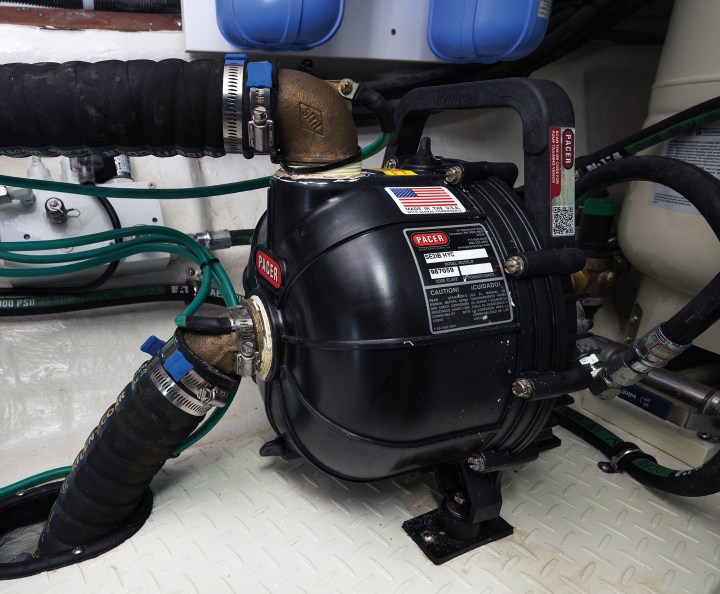
Primary and Backup Pumps
Identical primary and backup pumps double dewatering capacity and simplify carrying spares. Installing them just above normal bilge level keeps those backup pumps pristine. Independent circuits ensure one tripped breaker doesn’t affect both the primary and backup.
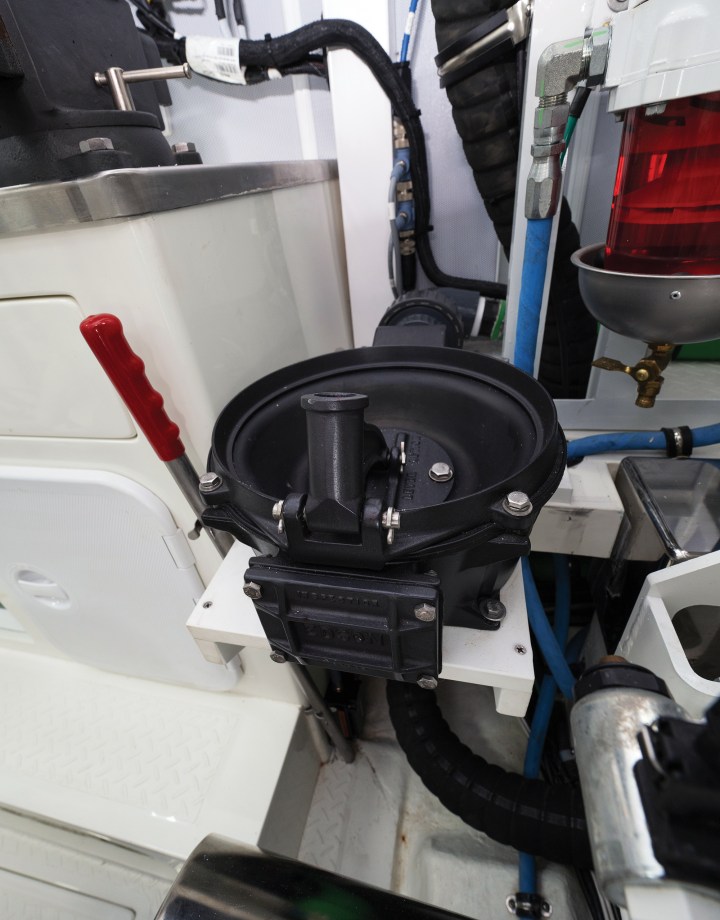
Particularly for offshore cruisers, though, that simple solution might not be best. Nordhavn, for example, opts for smallish 320-gph Whale or Jabsco diaphragm-style “drying” pumps. Those sit high above bilge water, not down in it like a typical centrifugal bilge pump. “They’re designed for spray, seepage, spillage—just the normal accumulation of bilge water,” Thomas says. Diaphragm pumps handle debris better than centrifugal pumps, and they pump bilge water levels lower, too.
A leak that exceeds that smaller pump’s capacity will be noticed sooner, and the bilge pump will not be able to keep up. Large backups, typically 3,700-gph Rule submersible pumps and 14,000-gph Pacer pumps on Nordhavns, bring enormous reserve capacity that’s reassuring while dealing with a calamity.
On many Nordhavn boats, those Pacer pumps draw through a manifold plumbed to each bilge. Hydraulic power, when available for stabilizers or thrusters, keeps pumps running even if they’re submerged.
“On our bigger boats, like the 96 or 120, there will be one off the hydraulic system and then another electric pump for an anchor wash, bilge dewatering and pressurizing the fire main,” says Nordhavn engineering manager Mike Telleria.
Plumbing and Pump Capacity
Rated pump capacity doesn’t account for hose length, bends and the height from pump to overboard discharge. Thomas says a generally accepted number is that you’re only getting about 40 percent the capacity of the pump by the time it actually gets overboard. On large boats with deep bilges, capacity dips even lower.
To mitigate those losses, choose smooth-walled hose rated for oily bilges, and avoid sharp bends. Be sure discharge hoses run smoothly uphill to overboard fittings, too. If the hose dips and then rises again, that creates an air gap followed by a water blockage that many centrifugal bilge pumps can’t push through.
The American Boat & Yacht Council calls for powerboat discharges to be 7 degrees above the waterline—that’s about 15 inches assuming a 20-foot beam. Anti-siphon loops mounted higher add reassurance, but at the cost of a higher head that decreases water flow.
Bilge Hygiene
When bilge water flows higher than normal or somewhere new, cast-off bits of wire insulation, cable tie trimmings, wood shavings and fiberglass dust can clog pumps and decrease flow. This can also increase amperage that burns out motors or trips circuit breakers.
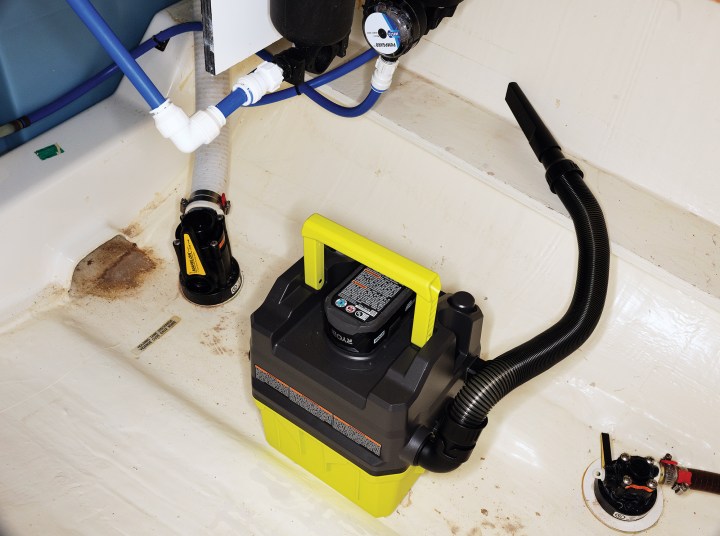
Remove that detritus with a battery-powered shop vacuum (or use a corded vac plugged into Ground Fault Circuit Interrupter receptacles), then flush nooks and crannies and wet-vac again. Change oil-absorbent bilge pads before they break down, and designate a place for fishing-line scraps so they don’t wash into the bilge.
Also watch for stowed gear that might shift and pin a float switch down or up.
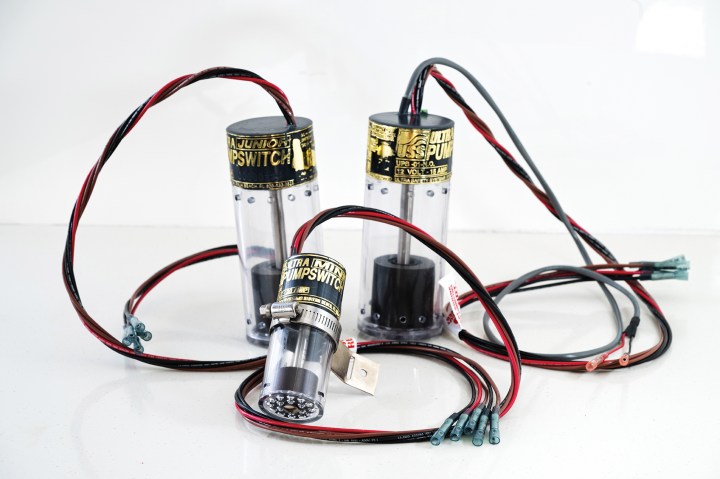
Switches and testing
While checking engines, steering gear and safety equipment, give bilge pumps attention, too. Check pumps by adding water to the bilge, engaging the manual switch and verifying the pump is pushing its usual overboard flow.
Next, go into the bilge and test the automatic switch, which might mean lifting the float until the pump starts or, possibly, pushing a test button or turning a knob on the side of the float switch housing. While you’re there, test the switch that activates the high water alarm.
Inspect those switches, too, particularly where wires enter the float. As the switch rocks in a partially filled bilge, copper wires become work-hardened and inflexible, and then wear the insulation from the inside out. Eventually, water seeps in and corrosion takes hold.
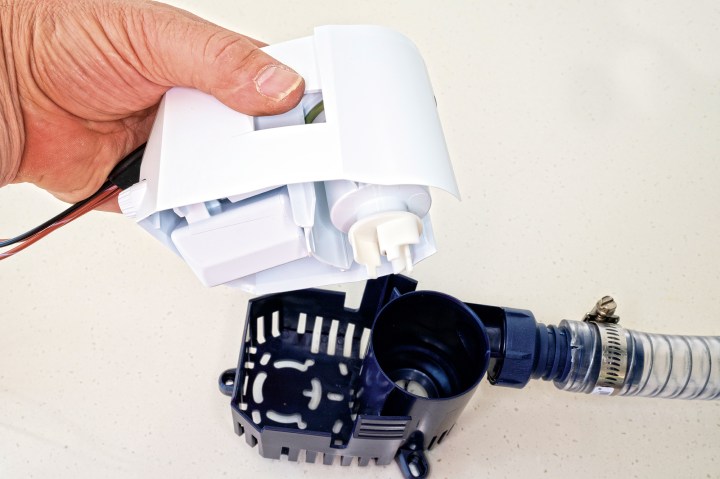
Inspect pumps for discoloration or swollen plastic that suggests they’ve been running dry and overheating. Pop them off their base and check inside for debris, too.
Automatic pumps eliminate the switch. They turn on briefly every few minutes and only continue to run when amperage indicates water resistance. However, fouled impellers or standing water in some bilge configurations can make automatic pumps cycle continually and burn out. Water-sensing electronic switches also eliminate moving parts, but they can be tricked into running after bilges are dry if wet bilge grime spans switch contacts.
The Ultra Bilge Pumpswitch avoids most problems with just one moving part: a float with embedded magnets that activates reed switches as it slides up a sealed stainless steel shaft. A clever hose-clamp mount allows vertical adjustment to set bilge water level, although testing the switch requires loosening that clamp.
Electrical connections
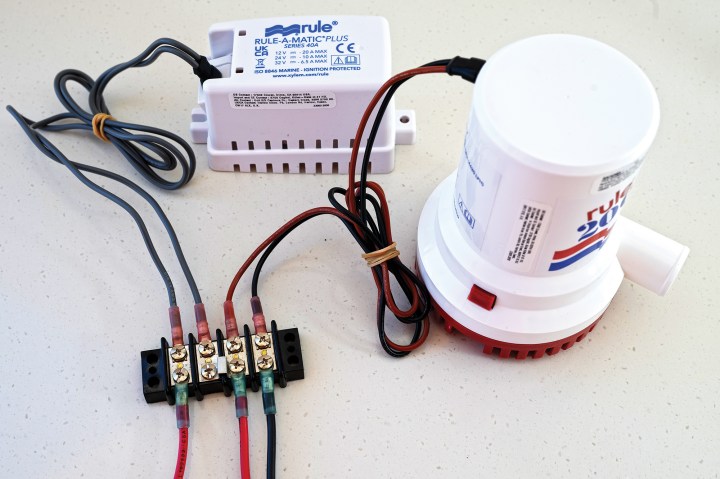
Heat shrink wire splices, secured well above bilge water, connect bilge pumps and switches. Most bilge pump circuits include one butt splice adjoining three wires—manual operation, the output from the automatic float switch, and the hot (usually brown) wire to the pump. A proper connection uses a step-down butt splice marked blue (for 14- and 16-gauge wire) for the single wire from the boat, and yellow (for 10- and 12-gauge wires) to adjoin the two wires leading to the pump and switch.
In a pinch, use a yellow connector to fit the pair, and then strip the end of the single wire to expose about double the normal length of copper, and fold those strands over.
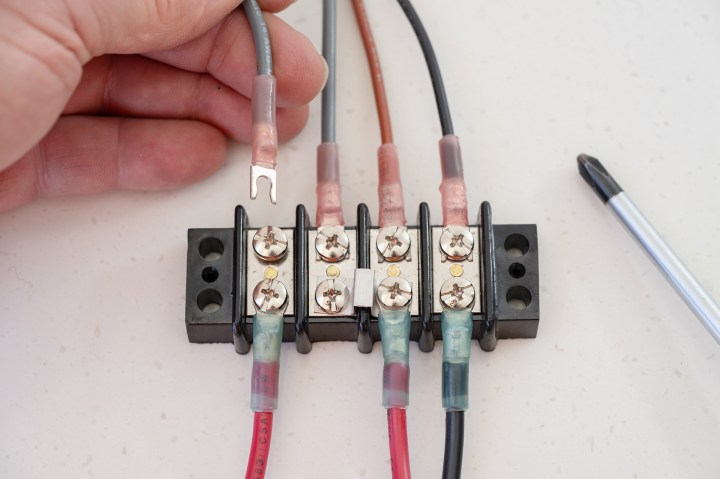
For a better connection and easier troubleshooting, consider making those connections on a terminal strip instead. A covered box is ideal, mounted well above the pump to stay dry.
To speed pump or switch replacement, use closed-eye ring terminals on the boat’s three wires (manual power, auto-switch power and DC negative). Pre-wire spare pumps and switches with captive forks that slip on without removing terminal strip screws. (Open forks aren’t ABYC approved since they’ll fall of if a screw vibrates loose.)
High-Water Alarms
On most boats, a high-water alarm is just another switch mounted a couple of inches above normal bilge level that activates a buzzer or bell. A particularly straightforward offering from Ultra Safety Systems utilizes just two wires to the switch. Power is supplied by two 9-volt batteries, so it’s simple to install and leaves the alarm completely independent of onboard DC power. Periodic testing ensures batteries are strong.
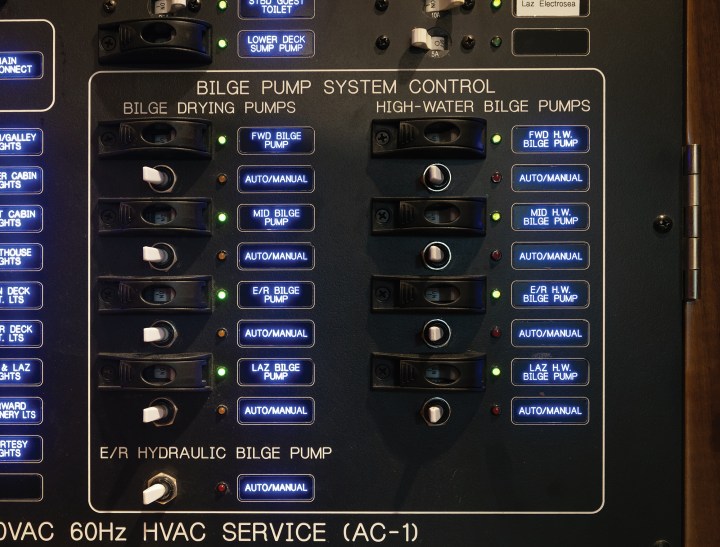
Nordhavn opts for two-tiered alarms. “As soon as that high-water pump comes on, that’s an issue you want to be aware of,” Telleria says. An audible alert and indicator light grab attention.
Whether that backup pump sounds an alarm or not, another switch, wired through an independent circuit, alerts there is a problem with the backup pump, or warns that water is rising faster than pumps can handle, so focus can shift toward life raft preparations.
Preemptive Alerts
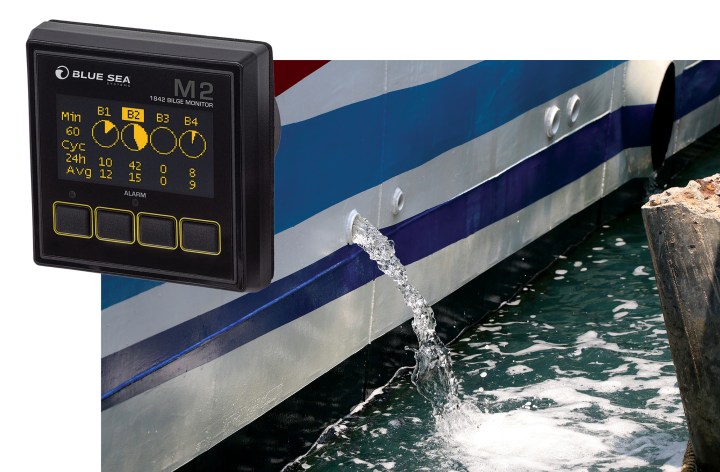
Rather than awaiting a fault, bilge pump counters predict problems. Blue Sea Systems Digital Bilge Monitor includes user-settable alerts if any of four bilge pumps runs for more minutes per hour or comes on more often per day than normal, indicating a leak or a weak pump.
The built-in audible alert “is pretty loud, and it also has an internal relay that will power our Turbo alarm,” says Kevin Patterson, a technical specialist at Blue Sea Systems. Required connections don’t interfere with existing bilge pump wiring. “Oftentimes we just tap into the manual switch wiring near the helm. We’re drawing milliamps; it’s really just a signal” requiring 18-gauge wires, he adds.
Other systems allow considerable customization and integration. “Maretron’s system goes from the mast all the way down to the bilge,” says Rob Cote, a senior technician for Ocean Currents Marine in West Palm Beach, Fla. “You can start with a base system, and if you notice something you’re looking to monitor, you can add it into that backbone.”
For bilge monitoring, an alert might indicate the number of pump cycles per hour, not just every 24 hours, or the duration of each individual cycle. A short delay mitigates false high-water alarms triggered by water sloshing in heavy seas. Temperature sensors on dripless packing glands indicate blocked raw water flow before a gland overheats and fails catastrophically.
“We can set up a visual indicator first, and then sound an alarm if it gets worse. There is a lot of flexibility,” Cote says.
Maretron can monitor most systems aboard, from engines to fire and intruder alarms. Email alerts notify absent skippers. Other options, like BRNKL (pronounced “barnacle”) or Siren monitor ship’s systems, including bilges, from afar through smartphone apps, but with less configurability.
With the goal of keeping water out of the boat in any emergency, the ultimate backup system is a good manual bilge pump that works even after an electrical fire or debilitating lightning strike. Some systems move a gallon of water with each stroke. A high-volume dewatering pump is even better, with small units removing from 90 gallons per minute up to more than 20,000 gallons per hour.
Whatever backup to your bilge you choose, it will be better than the old truism that the best bilge pump is a scared sailor with a bucket.
This article originally appeared in the October 2026 issue of Passagemaker magazine.