There was a time when cruise control and power windows were reserved for luxury cars. Today, they’re in even the most basic models. Drivers have accepted them as standard features, and no one suggests you should crank your own windows to prove you’re a better driver.
And yet, step onto a dock and bring up bow thrusters, stern thrusters, joystick controls or wireless remotes, and you’ll still hear the same replies. “That’s cheating.” “You’re safer if you learn to handle your boat without all of it.”
Sometimes, these things are said with a grin. Sometimes, they aren’t.
I say nonsense. In fact, you could argue the opposite. Features like cruise control reduce fatigue. Power steering improves control. Keeping both hands on the wheel while a momentary touch handles your window reduces distractions. These are no longer luxuries. They’re safety systems.
What we’re really talking about here is not whether you have the skill to handle your boat with just basic controls. We’re talking about whether we’re willing to use the tools available to reduce risk, increase control and make better decisions at the helm.
There is a persistent belief in boating that struggle equals competence. That if you can muscle a boat into a slip using only throttles, gears and a rudder, you’ve somehow proven yourself. But boat handling isn’t a character test. It’s an exercise in control. And control, especially at low speeds, is often limited by physics more than by experience. Windage, current, prop walk and limited rudder authority all conspire to reduce your margin for error just when precision matters most.
Bow and stern thrusters don’t remove skill from the equation. They add control to it. They give you the ability to move the boat laterally without building headway. They help you stop drifting before it becomes a problem. They allow small, precise corrections instead of large, reactive ones.
That’s not cheating. That’s seamanship.
Time is Safety
Most docking mishaps don’t happen because someone fails to understand the fundamentals. They happen because things start to get away from them, and they run out of time to recover. The wind catches the bow. The current grabs the stern. The angle increases, corrections become larger and, suddenly, the situation is no longer controlled.
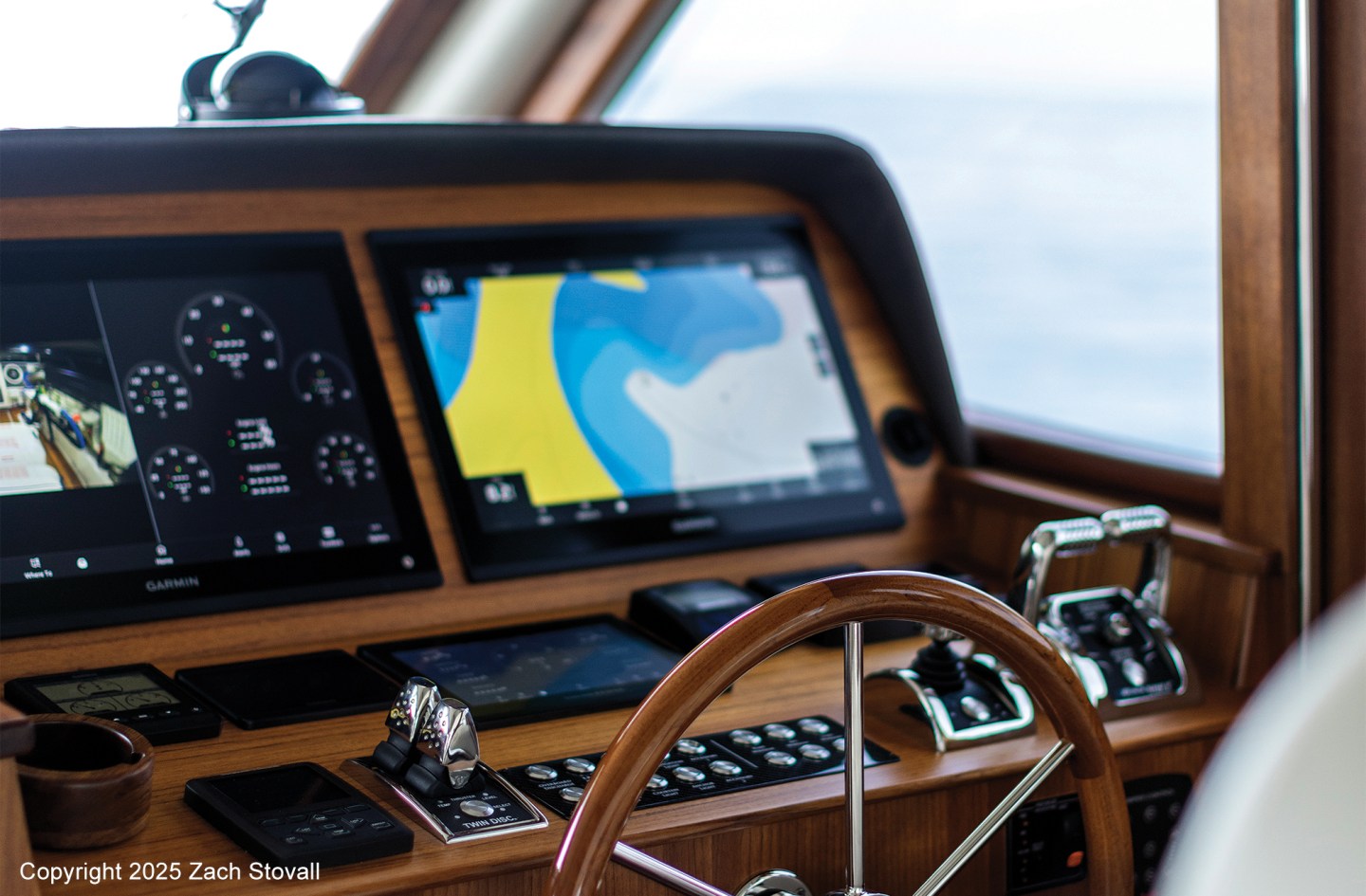
Modern tools buy you time. A bow thruster can stop a swing before it builds momentum. A joystick can translate multiple control inputs into a single, intuitive movement. A wireless remote allows you to be where you need to be, at the stern or on the side deck—all while maintaining control of the boat.
What you need is time to think. Time to correct. Time to keep a small mistake from becoming a big one. And time, in close quarters, is safety.
Reducing Risk
There’s another piece of this conversation that often gets overlooked: workload. Operating a boat in tight quarters can be mentally demanding. You’re managing wind, current, spacing, lines and fenders, and often communicating with crew, all at once. Add stress to that equation, and performance drops.
This is where systems like joystick control and digital positioning come into their own. They simplify complex control inputs and allow the operator to focus on the bigger picture: situational awareness. Instead of thinking about which engine to bump, how much throttle to apply or how to counter prop walk, you can think about where the boat needs to go.
That reduction in cognitive load isn’t laziness. It’s exactly how modern safety systems in aviation and automotive design are intended to work, freeing the operator to make better decisions.
In commercial and professional settings, no one is turning down tools that improve control. The best captains use every tool available. Tugboats use powerful thrusters and advanced control systems. Dynamic positioning keeps vessels stationary in open water with remarkable precision. Pilots rely on sophisticated systems to manage complex approaches.
No one at those helms is saying, “Let’s do this the hard way.” They’re saying, “Let’s do this the safest way.” Recreational boating should be no different.
Skill Still Matters
None of this is an argument against learning the fundamentals. You should absolutely understand how your boat behaves with wind and current. You should know how to handle it if a thruster fails or a system goes offline. But understanding the basics and using modern tools are not mutually exclusive.
In fact, the best operators do both. They understand what the boat wants to do, and then they use every available tool to manage it more precisely. The presence of technology doesn’t replace seamanship. It raises the bar for it. Because now the question isn’t, “Can you get the boat into the slip?” It’s, “Can you do it consistently, smoothly and without drama?”
There’s one more point that often gets dismissed too quickly: Enjoyment is not a trivial benefit. Boating is supposed to be enjoyable. It’s supposed to be something you look forward to, not something that fills you with anxiety every time you approach a crowded marina.
If modern tools make docking less stressful, more predictable and more controlled, that has real value. It means more people stay in boating longer. It means crews are more relaxed. It means fewer shouted instructions and fewer tense moments at the dock. And perhaps most important, it means fewer accidents
Moving Past the Myth
The idea that using thrusters or joystick controls is somehow cheating comes from a different era, one when those tools didn’t exist, when skill was defined by working around their absence. But boating, like everything else, evolves.
We don’t navigate by sextant when GPS is available. We don’t avoid radar because it makes things too easy. We adopt tools that make us safer, more capable and better informed.
Modern boat handling systems belong in that same category. They are not shortcuts. They are not crutches. They are tools, well-designed and highly effective, that allow you to operate your boat with greater precision, reduced stress and improved safety. If you have a tool that makes docking measurably safer, refusing to use it isn’t bravery. It’s bad risk management.
And if using these tools means fewer bent rails, scratched hulls and close calls at the dock, then perhaps the real question isn’t why we use them. It’s why anyone would choose not to.
This article originally appeared in the July/August 2026 issue of Passagemaker magazine.