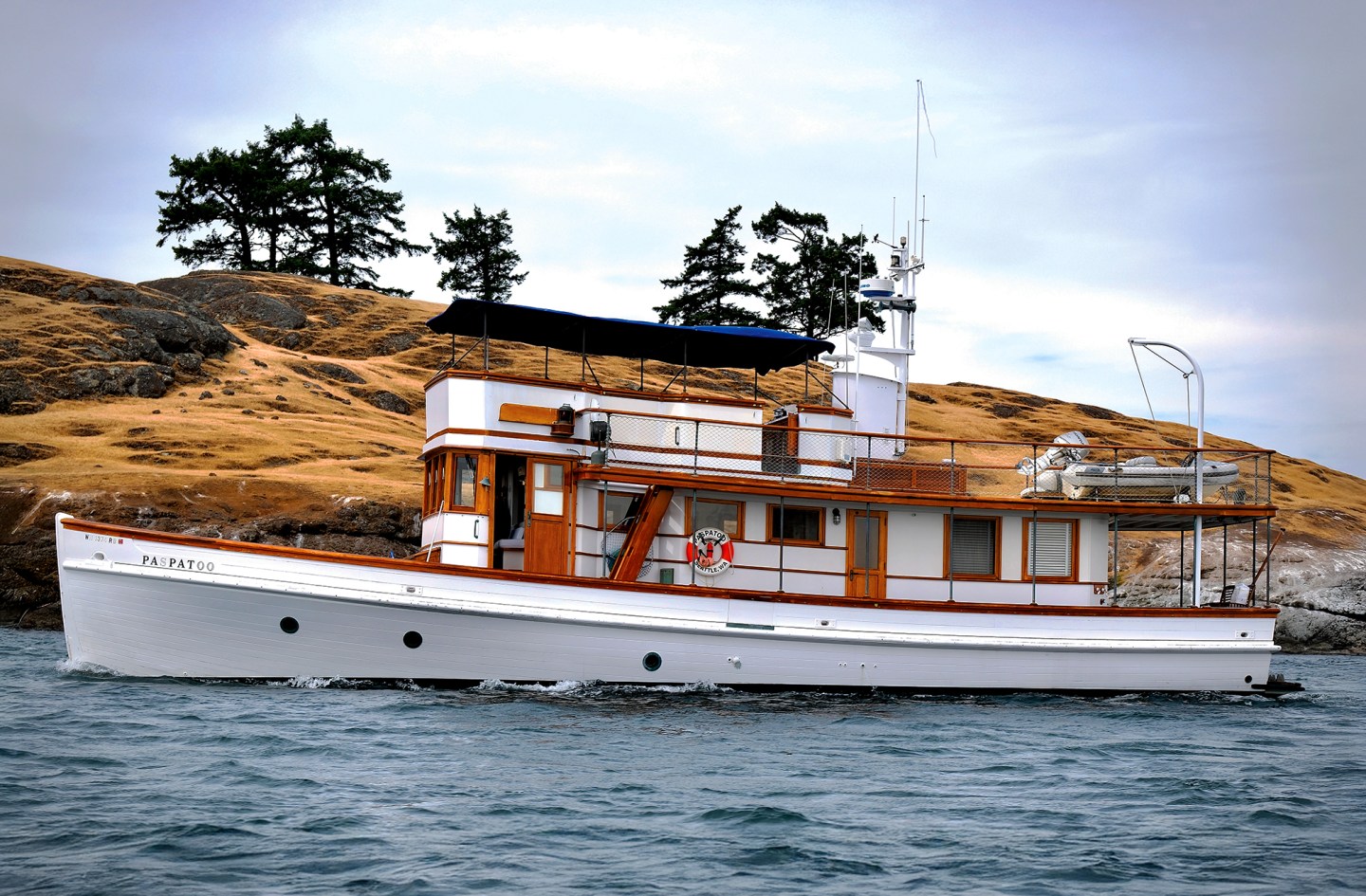
“Fast trawler” is an oxymoron, like “jumbo shrimp.” A trawler is technically a type of fishing boat: full displacement with round bilges. Trawlers are designed to go anywhere, handle the roughest of seas, and safely and efficiently carry a load. They are also slow—not because fishermen particularly want to go slow, but instead because the characteristics of a full-displacement hull are better for seaworthiness, fuel efficiency and carrying a load.
Like any full-displacement hull, these boats will never go significantly faster than their hull speed, and they often have relatively small engines compared to similar-length planing hulls. But nowadays, the word “trawler” is applied much more broadly to a style of boat that can share few, if any, fishing trawler characteristics.
Fast trawlers are often advertised as offering the seaworthiness and fuel efficiency of a full-displacement trawler, but with a turn of speed when skippers want it. There’s definitely some truth to those claims, but the design trade-offs required to get that extra speed potential are significant. In my humble opinion, they disqualify these boats for the trawler moniker.

The first and most important compromise for fast boats is displacement. Heavy boats are just more comfortable in a seaway. While advances in hull design and computer modeling have improved seakeeping ability, there’s no replacement for displacement. Even the cleverest designer cannot repeal the laws of physics. The momentum of a heavy hull provides a smoother, gentler motion in a seaway.
Unfortunately, one of the keys to making a boat faster is making it lighter. Getting above hull speed requires the boat to lift up out of the water and get on plane. The heavier the boat, the more horsepower required to get the hull to lift. That’s why many full-displacement recreational trawlers have one engine of a few hundred horsepower (or even less) compared to two 500-plus-hp engines required to get even a moderate-size boat up on a plane.
Worse yet, running these fast boats with two large engines at slower, more fuel-efficient speeds also means the engines spend a good deal of their lives severely underloaded, a situation that can decrease their longevity and reliability.
Another key compromise designers make for speed is flatter hull shapes with harder chines. Again, these shapes are better for getting a boat to lift out of the water and up on a plane. But the shape of the hull doesn’t change when the boat slows down to displacement speeds, and those flatter hull sections and hard chines make the boat less comfortable in waves. The motion of these lighter, hard-chined boats tends to be more severe compared with a rounder soft-chined hull.
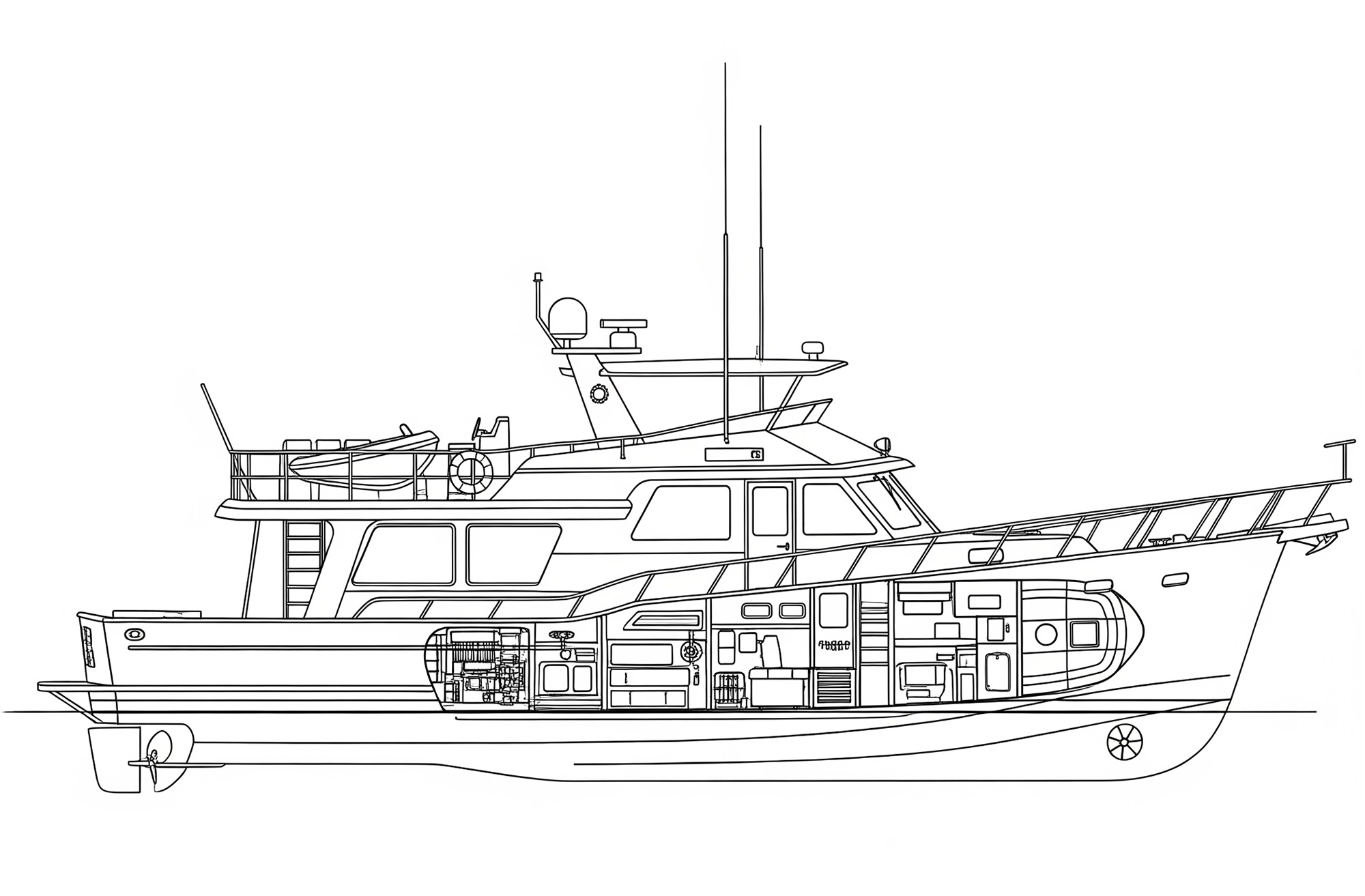
In addition, if you spend any significant time away from a marina, you’re almost certainly going to find yourself in the engine room—perhaps outside the reach of an easy service call—doing routine maintenance or more significant repairs. When access to systems is difficult or uncomfortable, such as with a lack of standing headroom, maintenance often suffers. Deep, round-bilge hulls with smaller engines naturally result in more-accessible engine rooms.
Yet another design trade-off is unprotected shafts, propellers and rudders. A full keel or skeg forward of the propeller increases drag, especially at high speeds, so most planing boats have exposed shafts, propellers, struts and rudders. As a result, those boats are much more susceptible to damage from floating logs and other debris—especially in the Inside Passage and Pacific Northwest. Hitting one of these floating logs at 15 to 20 knots is almost certain to damage the running gear, if not the hull itself, significantly.
By contrast, full-displacement trawlers usually have a full keel or at least a skeg forward of the propeller. The rudder is typically hung abaft the keel and connected at the bottom to it. This protects the propeller and rudder from damage caused by floating debris.
These design compromises for fast boats are the primary reason why I favor slower, full-displacement trawlers. But going slow is also a mindset. Many full-displacement trawler owners started out as sailors. We ascribe to the philosophy that cruising is as much about the journey as the destination. The more relaxed pace of the full-displacement trawler gives us time to enjoy the scenery and wildlife.
For me, slow and steady wins the race. Even in power cruising.
This article originally appeared in the October 2025 issue of Passagemaker magazine.