Illustrations by Jim Ewing
Grand Banks 42 Europa
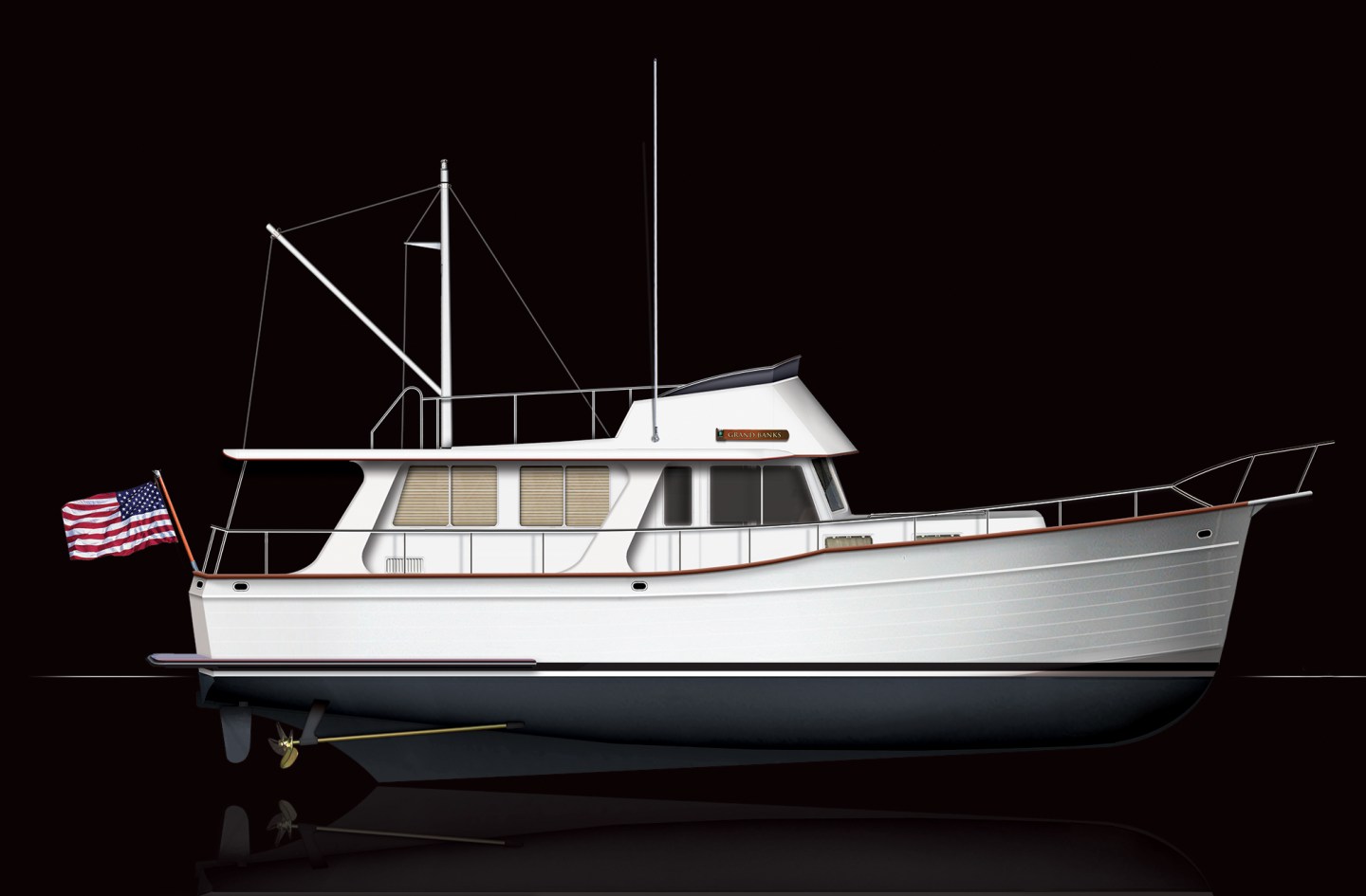
Designer Ken Smith’s Grand Banks 42 is an acknowledged cruising classic, a salty trawler yacht with an aft cabin, sturdy wheelhouse and workboat-inspired profile that was built for nearly 40 years. The Europa version was an offspring. The Europa rode the same semi-displacement hull as the original, but the look was more contemporary, and an extended salon replaced the aft cabin, capped by a hardtop that covered the cockpit and side decks.
The boat was first built in wood for the European market, hence the Europa name. Introduced in the United States in 1979, the fiberglass 42 Europa was in production for a quarter century, although with a brief halt.
There was plenty of room on board this well-built cruiser. The big flybridge had a helm and companion seats forward and space for a table and chairs or an L-shaped lounge aft. A dinghy could be stowed on the extended hardtop.
The salon, accessed through sliding doors aft, had Grand Banks’ trademark parquet sole and satin-varnished teak. Chairs, a drop-leaf table and an L-shaped lounge made for a comfortable living space, which stretched from the lower helm to the cockpit on a single level. The galley-up was forward to port, the helm to starboard.
The boat’s two staterooms were forward, down three steps. The master had a queen-size berth, and teak joinery added a classic touch. The guest stateroom was set up with either twin berths or a double berth. In the shared head compartment were a VacuFlush marine head, a Corian counter with a molded sink and a stall shower.
Production paused in 1991, and a version with a larger forward cabin debuted in 1996. The new model had an extended cruising range with its 600-gallon fuel supply and trawler running speeds. With Grand Banks’ solid construction and creature comforts, the 42 Europa was a boat that deserved to be cruised aboard.
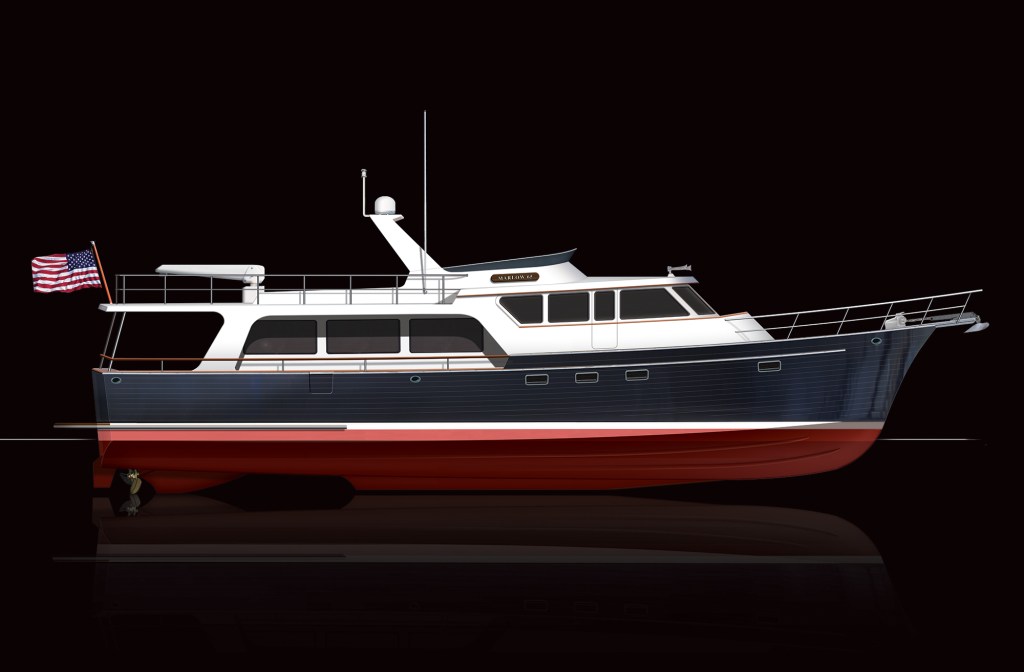
Marlow 65 Explorer
Marlow founder David Marlow was known for his long-distance luxury cruisers, but maybe more so for his hull designs, all of which were capable and efficient in deep water. Marlow co-designed the 65 with Doug Zurn, the Marblehead, Mass., naval architect who gained fame with his creation of the Shelter Island 38.
“The 65 was our design number 9954, which we started in 1999,” Zurn said. “It was built in Taiwan at President Marine, where the tooling was constructed to allow the development of several other boats with similar characteristics, notably the Marlow 61C and the 57C. The original boat was also called the 65C, with the C designating a conventional stern and differentiating it from an E for a Euro-style stern developed later.”
Viewed in profile, the underwater portion of the hull showed several distinctive features. There was the modestly deep forefoot curving upwards to a clipper-profile stem beneath substantial bow flare, a pair of lifting strakes between the shallow keel and a full-length chine, and a long clean run warping to a 14-degree transom deadrise. A comparatively shallow keel with a depth of 4 feet, 5 inches added tracking ability. Abaft of the keel, a pair of finlike struts enclosed the run of the shafts to the prop, adding protection while helping to reduce the drag of conventional running gear.
For beauty’s sake, as well as a lower center of gravity, the profile of the deckhouse was kept low. On the flybridge, there was abundant room for RIB storage, large lockers, built-in seating and a centerline helm.
The lower helm was situated slightly to starboard of centerline, creating space for a lounge and table to port for those who wanted to keep the helmsman company. Two doors lead from the bridge deck to the side decks, which are covered by flybridge overhangs. The galley abaft the helm was designed to be large, U-shaped and well positioned to serve those in the salon or on the bridgedeck. Belowdecks, the accommodations included an amidships master stateroom, large forward guest stateroom, and portside guest stateroom.
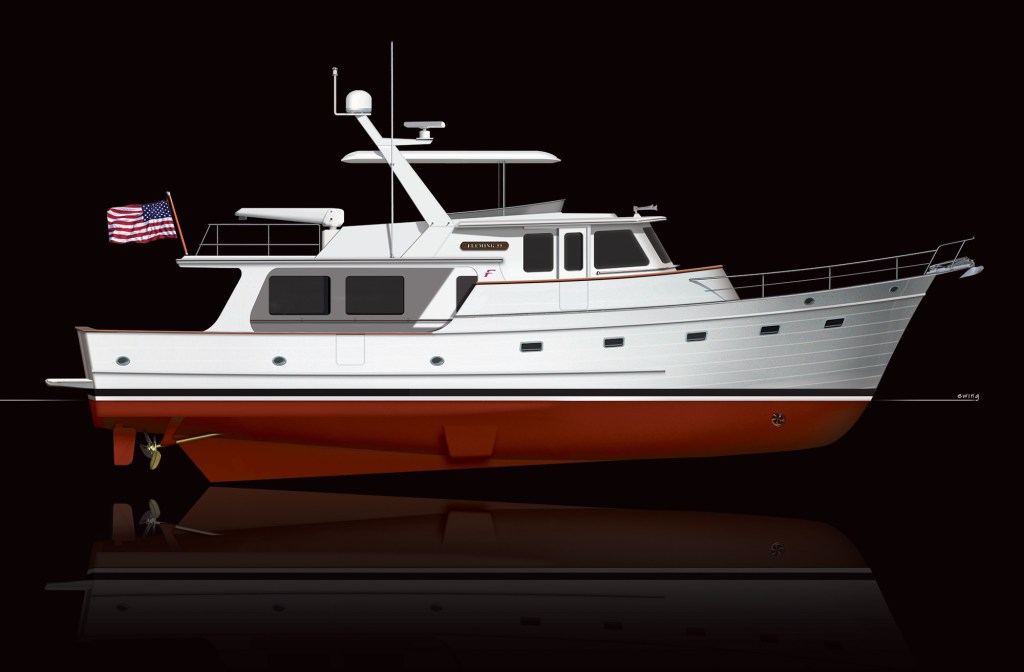
Fleming 55
The first Fleming to arrive in the United States was offloaded from a freighter in Long Beach, Calif., during November 1986. It was a 50-footer, built in the same hull mold as the Fleming 55. A dam had been inserted in the mold to shorten her because at the time, it was believed a couple could not operate a boat over 50 feet.
Manufactured in the Tung Hwa shipyard in Taiwan, the Fleming 55 was the brainchild of Tony Fleming, a trained aeronautical engineer and a former technical director for American Marine, the maker of Grand Banks trawlers. With nearly 25 years of boatbuilding experience in the Far East, Fleming wanted to build the ultimate open-water cruising yacht for a couple with occasional guests. The design was a semidisplacement hull with a high, flared bow to cope with tall waves, a long keel that would protect the running gear from grounding, and a low center of gravity to optimize comfort underway.
The dam in the mold was soon ditched, and subsequent Fleming 55s became 60 feet, 9 inches long (including the bow pulpit and swim platform). Her fine entry at the stem progressed to rounded bilge sections and then to hard chines and a modified deep-V deadrise angle at the transom. With a beam of 16 feet, a draft of 5 feet and a fully loaded displacement of 80,178 pounds, the 55 had enough volume to provide comfortable living spaces, carry 1,000 gallons of fuel for long-range cruising, and mount twin diesel engines for efficiency and reliability.
Other noteworthy features were a Portuguese bridge, a raised and enclosed pilothouse helm, a flybridge helm, a boat deck to keep the dinghy off the transom, and wide side decks with deep bulwarks for safety.
Over the years, Fleming continuously refined the 55’s materials and equipment while never changing the classic look and purpose-designed features. Since 1986, thousands of large and small tweaks have been made to the 55, an approach that has burnished the company’s reputation among serious distance-cruising owners.
Fleming eventually moved onto one of his boats to travel the world while continually sending ideas to refine the company’s boats. He never wavered from making the best boat money could buy, even in the face of competition that would build to a lower price.
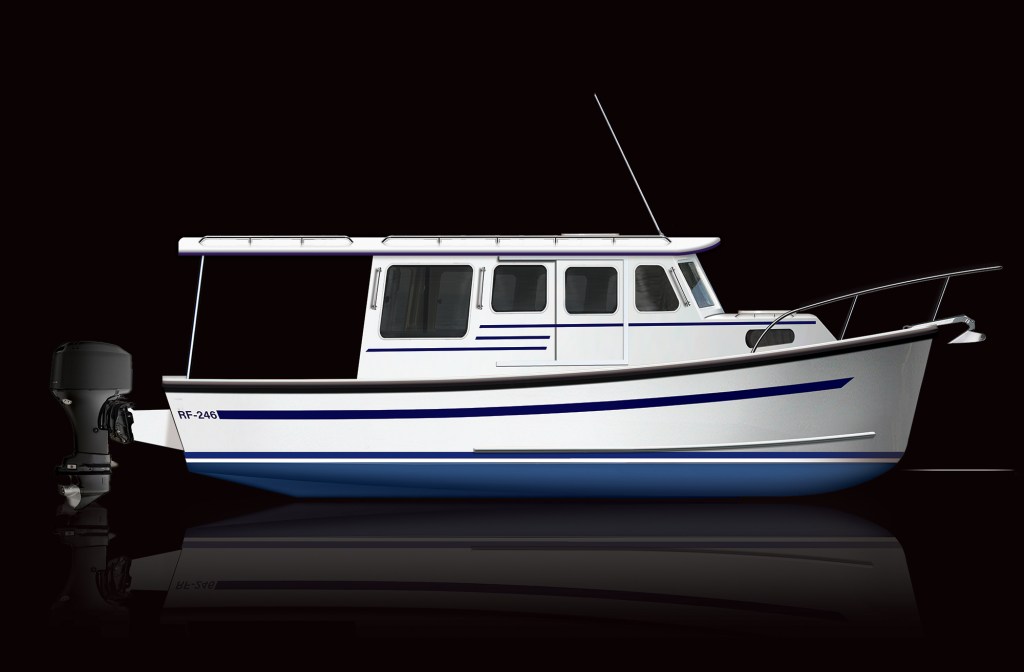
Rosborough 246
Today, quite a few boatbuilders use the term “pocket trawler” to describe the models they build. But back in 1987, when this husky little cruiser came out of the Canadian Maritimes, it just may have been the first of that genre.
Designer and builder James “Doug” Rosborough founded Rosborough Boats in Halifax, Nova Scotia, in the 1950s. The yard was known for traditional wooden sailing vessels until 30 years later, when his son, James (known as “Bob”), took over the business and turned the focus toward fiberglass powerboats. The younger Rosborough experimented with an 18, a 28 and a 35 before settling on a trailerable 25-footer for couples to take on weekend cruises. The Rosborough 246 F debuted in 1987 and caused a buzz. The pocket trawler was born.
There were two versions of this model: the wheelhouse and a sedan cruiser. In both, the standard layout included a V-berth that converted to a table and seating area; an enclosed head compartment with a marine head, sink and shower; and a dinette with bench seating and a table that converted to a berth. Galley gear could include a refrigerator/freezer and stovetop, along with a sink and stowage. The steering station was to starboard with a pedestal seat and a sliding door to the deck. Recommended power was a pair of outboards—150 hp maximum each—or a single diesel of about 190 hp.
Rosborough produced about 500 of the boats through the early 2000s before selling to Eastern Boats of Milton, N.H. Now marketed as a series from Rosborough Boats USA, there are four models in the line: the Custom Wheelhouse, Halifax, Digby and Yarmouth, with the latter three names reflecting the design’s Nova Scotia roots.
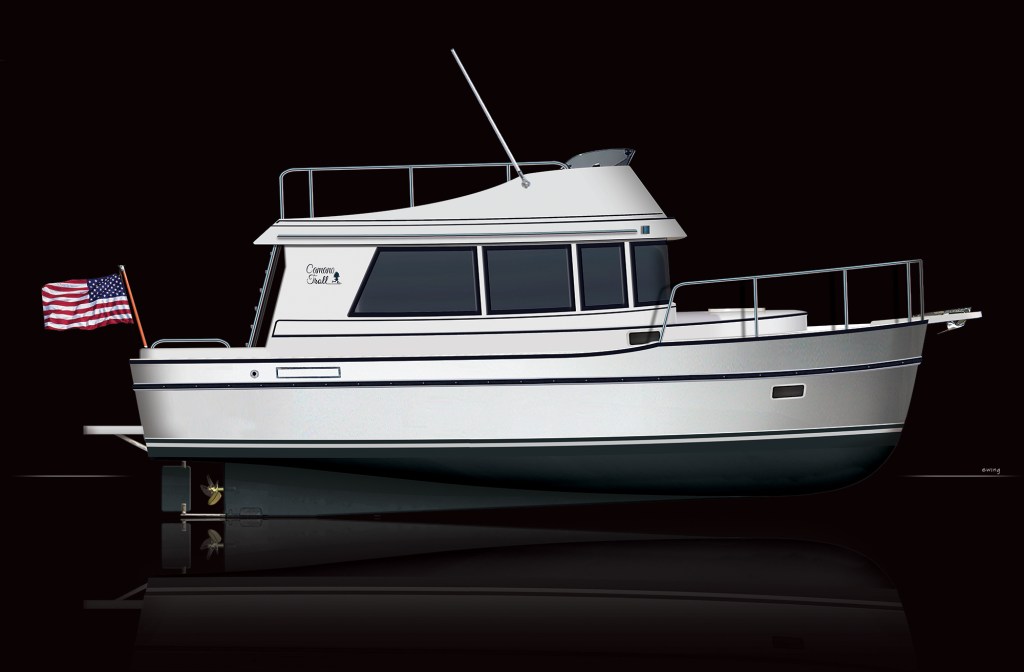
Camano 31
Naval architect Bob Warman of Vancouver, Canada, drew the lines for the Camano 31. When he built, launched and sold the first 31 (originally referred to as the 28), his design immediately garnered interest, as it borrowed some of the form and functionality of working vessels in the region. Over the next nine years, Warman made more than 125 of the compact cruisers.
The Camano 31 is a capable coastal craft with the bones of a workboat, one that can carry its crew safely across open stretches of water efficiently and comfortably. It has a well-flared bow and a sharp-angled, near-plumb stem that can part waves and shed spray quickly. Those elements give way to rapidly widening sections that disappear below the waterline.
A couple of features below the waterline are notable, including a pair of lifting strakes and full-length soft chines, which add lift and stability as the semidisplacement hull picks up speed. There’s also a full-length keel that widens significantly just abaft amidships to create a hollow, wedgelike shape that adds buoyancy and prop protection. It also allows for the installation of a single Volvo Penta diesel (150 or 200 hp) farther down in the hull, where it creates a low center of gravity and a comparatively flatter angle for the prop shaft. As a result, usable torque is optimized. The 31 can achieve a 12-knot cruising speed and 16-knot top end, on average.
Warman gave the Camano 31 plenty of interior volume, thanks to a 10-foot, 6-inch beam and a draft of 3 feet, 3 inches. He also drew a deckhouse that uses nearly the entire beam (there are side decks, but they’re not protected by bulwarks). On the main deck, there’s a convertible bench seat to port, room for two single seats to starboard and a single seat at the helm. Down three steps is a galley to port and a forward cabin with a V-berth that’s steps away from the enclosed head. Interior finishes include teak and mahogany, depending on the year of manufacture.
After Warman sold Camano in the late 1990s, the tooling passed through several owners. About 270 models were built before the current owners, Scott and Lisa Helker of Seattle-based Helmsman Trawlers, bought the tooling and upated the design.
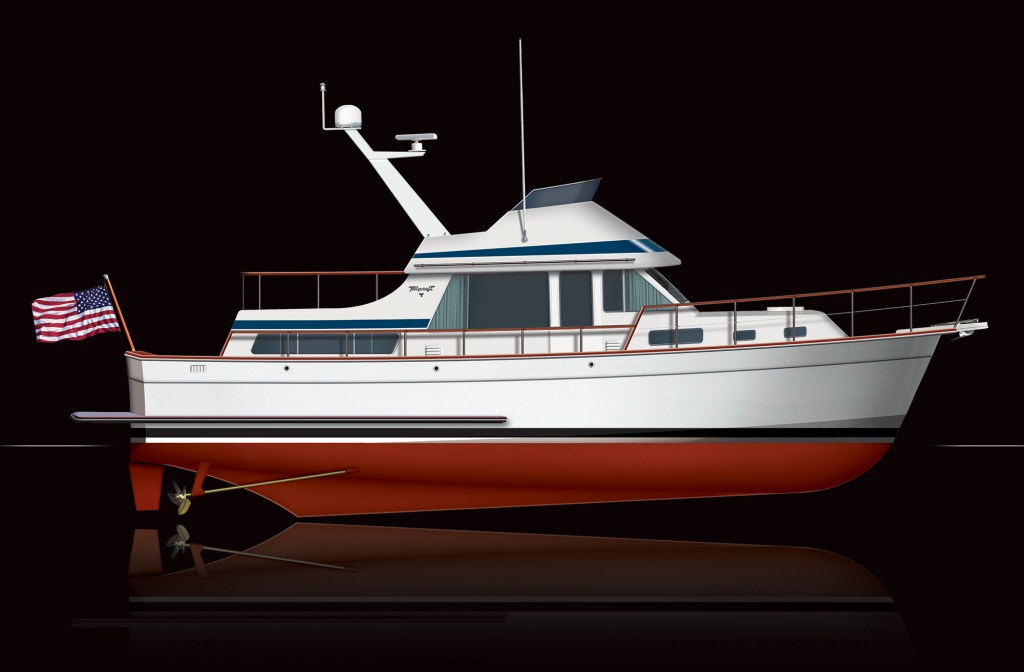
Tollycraft 48
When R.M. “Tolly” Tollefson founded Tollycraft Boats in 1958 in Kelso, Wash., he could hardly have imagined that he would become an icon in Pacific Northwest boatbuilding, or that his boats would be sought after as capable open-water cruising vessels on both coasts. From 1952 to 1967, Tollycraft built four wooden models ranging from 24 to 34 feet. They became the foundation of the company’s first fiberglass designs in 1967.
The Tollycraft 48 Motor Yacht was introduced in 1976. Noted Pacific Northwest naval architect Ed Monk Jr. designed the semidisplacement hull with a springy sheer, upswept bow, sharp entry and a modestly raked stem with a deep forefoot to handle large waves. With a draft of 3 feet, 2 inches, a full-length keel to protect the running gear and a displacement of about 38,000 pounds, the 48 had excellent seakeeping characteristics and a comfortable ride across a wide range of conditions.
Monk used the 15-foot, 2-inch beam to give the boat a modest aft cockpit and wide side decks with bulwarks and handrails that ran almost the full length of the boat. The layout included two staterooms, a raised salon, a dinghy storage area atop the aft cabin top, and a wide flybridge with two captain’s chairs and an L-shaped lounge with a table.
Notable features in the main salon included a lower helm station to starboard, twin access doors to the side decks and internal stairs to the flybridge. The U-shaped galley was three steps down, forward and to port of the lower helm. Early layouts showed a banquet table to starboard and a large forward stateroom with an ensuite head. The owner’s stateroom aft had a double berth, abundant stowage lockers and an ensuite head.
For the first 10 years of its production, the 48 MY was powered by twin 210-hp Caterpillars or a pair of 320-hp Cat 3208TA diesels. Later models were driven by a pair of 300-hp Cummins diesels or 375-hp Cats.
In 1991, the 80-year-old Tollefson took delivery of his own 48 MY, a striking blue hull with Tolly on the transom. He spent the next 10 years cruising the American and Canadian coasts of the Pacific Northwest and took one trip to Alaska. He retired from cruising at 90 years of age and died in 2011, four months after 165 “Tolly fans” serenaded him at his 100th birthday celebration.
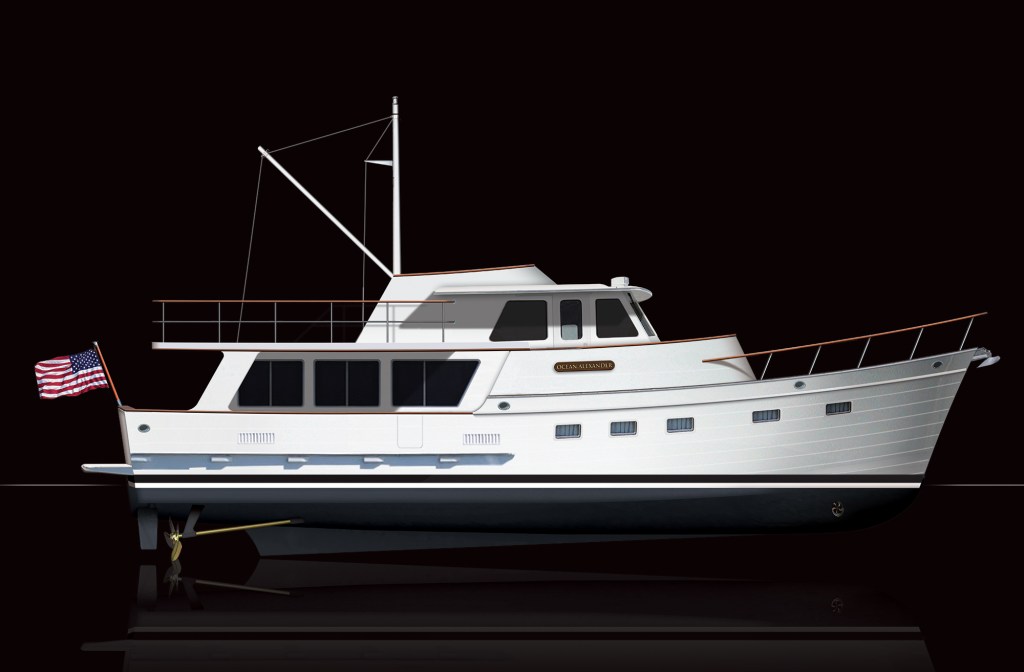
Ocean Alexander 50 MK 1
Debuting in 1978, the Ocean Alexander 50 Pilothouse MK I launched with an impeccable design pedigree. This was a liveaboard yacht based on a hull designed by
one of America’s leading naval architects, Robert Edwin “Ed” Monk. He is the son of pioneering trawler designer George Edwin William Monk (aka Ed Monk Sr.), who produced some 3,000 designs during a 40-year career
that began in 1934. Working in wood, Monk Sr. produced powerboats that were not only practical and efficient, but also, as author Dan MacNaughton put it, “interesting, harmonious and functional.”
With the Ocean Alexander MK I, Ed Monk Jr. brought the family tradition of great design to a new generation of boaters. The comfortable, rugged yacht recalled the Alaskan trawler with its flared bow, high topsides and distinctive Portuguese bridge that protected a sturdy pilothouse. Monk started with a semi-planing hull designed to achieve speeds between 12 and 14 knots with a pair of efficient and relatively low-horsepower engines. Standard propulsion was twin 270-hp Cummins diesels or 320-hp Caterpillars.
He also made practical use of the 50-footer’s interior space, as illustrated by the Ocean Alexander’s three-level layout, featuring a salon with lounge seating and dining for up to six, a U-shaped galley up and a raised pilothouse with side doors and a watch berth. The master stateroom was amidships, with a queen-size berth and a head compartment with a shower. There were also alternate layouts with one or two guest staterooms (plus a guest head compartment) available.
Built in Taiwan through 1983, the Ocean Alexander Pilothouse MK I remains a popular and enduring design that attracts trawler boaters today, more than a quarter-century after the final hull was built.
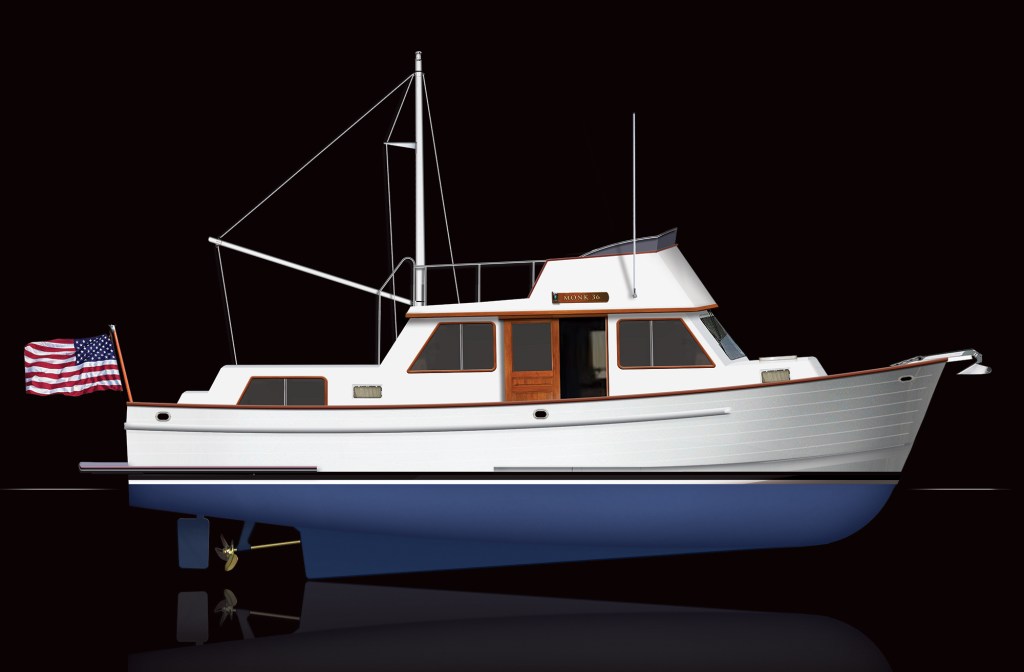
Monk 36 Trawler
It’s been called a cruiser’s cruiser. The durable Monk 36, with its classic profile, helped to popularize the recreational trawler during the 1980s. It turned what was at first a niche market into one of America’s most popular boat types.
At just under 40 feet length overall with a 13-foot beam, the Monk 36 was designed with a semi-displacement hull, a full keel and a protected prop and rudder. The bow was tall and flared, and the hull had a high freeboard all around with molded-in spray rails.
The cabin had a master stateroom aft and a V-berth forward, each with its own head compartment. The salon was laid out with teak furniture, and there was a sliding door at the lower helm. There was also a helm station on the flybridge. Teak trim and teak-and-holly soles were used throughout. The L-shaped galley had a home-style refrigerator/freezer, a three-burner stove and an oven. There was a bathtub in some early models, too.
A single 120- to 135-hp diesel provided an average speed around 7 knots, where fuel use was a stingy 5 gph. Later models were equipped with a 220-hp Cummins diesel engine, increasing the cruise speed to 9 or 10 knots.
The Monk 36 was first built in Taiwan in 1982, and then in Nova Scotia beginning in 1992. The model was in production until 2007, with more than 250 hulls delivered to owners.
The designer, Ed Monk Jr., established a reputation for designing rugged, dependable boats. As a veteran Pacific Northwest delivery captain told us for a story published a decade ago: “Ed Monk Jr. designs seem to flow easily through the water. When it comes to performance and seakeeping, his designs are my gold standard.”
This article originally appeared in the May/June 2026 issue of Passagemaker magazine.