

Boaters are planners by nature. We think in contingencies. We carry spare filters, belts, impellers, pumps, hoses and tools—sometimes enough to rebuild half the boat at anchor. We talk about fire, flooding, medical emergencies and abandon-ship scenarios. We rehearse what we’d do if the engine quit, the weather turned ugly or someone went overboard.
But there are two failures that few trawler owners plan for, and that can leave you just as helpless: loss of steering and loss of engine control.
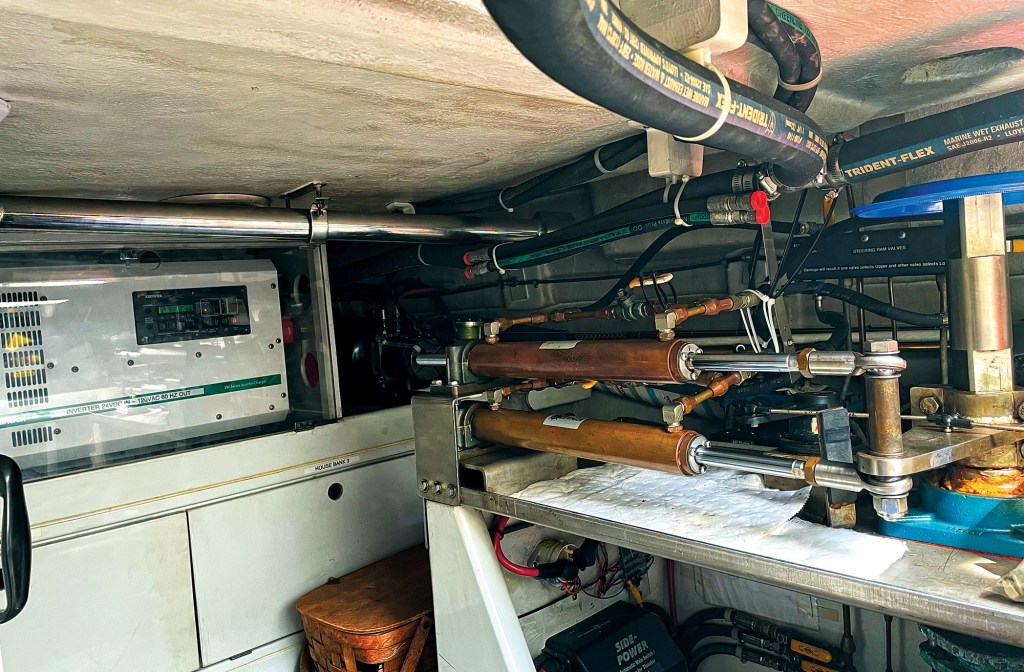
Modern trawlers are almost universally dependent on electronic and hydraulic systems for throttle, transmission shifting and steering. The wheel turns hydraulic pumps, not cables. The throttle lever sends signals, not mechanical force. When everything works, the system is smooth, precise and effortless. When it doesn’t, you can find yourself with a perfectly healthy rudder and engine, and no way to command either one.
Loss of steering rarely announces itself dramatically. More often, it shows up as something vague and unsettling: The wheel feels oddly light, heavy or disconnected. You turn to starboard and nothing happens, or the boat responds inconsistently or with a delay. The problem could be a failed pump or split hydraulic line. Less likely, but not impossible, is a failure in mechanical linkage.
Regardless of the cause, the results are all the same: You’ve lost control of steering.
Most trawlers are equipped with an emergency tiller. It’s usually a heavy but simple metal arm designed to clamp onto the rudderpost. On paper, it’s the answer to total steering failure. In reality, it’s nearly an impractical afterthought.
The emergency tiller is typically stored in the lazarette, sometimes still wrapped in plastic from the day the boat was commissioned. On sailboats, the emergency tiller may come up through a dedicated opening in the cockpit sole, making it at least theoretically usable underway. On trawlers, it usually requires opening hatches, clearing gear and installing the tiller deep in the stern of the boat—exactly where motion is worst and access is hardest.
Here’s the uncomfortable question: Do you know where your emergency tiller is? More important, have you ever practiced attaching and using it?
In theory, the emergency tiller will be used to steer the boat until a repair is made or to a safe harbor if a repair at sea cannot be performed. At best, it is a temporary solution to regain basic control, not something you will use to steer comfortably to your destination. In large seaways, it often provides just enough authority to prevent broaching or uncontrolled drift, not the full control you’re used to under normal systems.
Many owners assume that if the rudder is intact, the emergency tiller will work. But steering a heavy displacement boat with a short tiller arm, at anything more than bare steerageway, can require tremendous effort. Hydrodynamic loads on the rudder don’t politely scale down just because you’ve lost hydraulics. At cruising speed, the forces can be overwhelming. Sometimes, they are impossible to overcome by hand.
That doesn’t make the emergency tiller useless. It makes speed management critical. The tiller may only be effective at idle, or when backing down to slow the boat enough for manual steering to be feasible. The best idea may be to lash the emergency tiller in the lazarette to hold the rudders straight, then use twin engines or thrusters to alter direction.
Loss of engine control is even more counterintuitive. The engine is running. It sounds fine. Oil pressure is good. Temperature is normal. But the boat won’t go into gear. Or worse, it won’t come out of gear. The throttle and shifter, which are typically one and the same on a modern trawler, have stopped working.
Electronic throttle and transmission controls are wonderfully reliable until they aren’t. A failed control head, a broken wire, a corrupted signal or a dead power supply can instantly sever the connection to the drive train. At that moment, the question isn’t: “Is the engine running?” It’s: “Can I command it?”
Do you know whether there is a manual override on your transmission? Unfortunately, most trawler owners have no idea. Some gearboxes have a mechanical lever on the transmission that lets you shift into forward or reverse by hand. Others require removing a linkage or solenoid, then repositioning a selector arm or plunger. Some electronic systems have a built-in emergency mode. It is important to know which you have.
Just as important: Do you know how to take the engine out of gear if the control system fails while engaged? That scenario is more than hypothetical. A boat stuck in gear, even at idle, would be dangerous in close quarters. Without the ability to shift to neutral, you may be forced to shut the engine down entirely, trading propulsion and control for safety.
It’s true that such failures are rare. But so are fires, abandon-ship situations and life-raft deployments. Yet most boaters are far more willing to plan for, or at least acknowledge the possibility of, those emergencies.
Planning for loss of steering and engine control doesn’t require new equipment as much as it requires familiarity. Find the emergency tiller. Install it at the dock on a calm day. Note what has to be moved to access the rudderpost. Decide where you would stand, how you would communicate with the helm, and how you would control speed.
Do the same with your engine and transmission. Locate the gearbox. Identify any manual controls or overrides. Read the documentation—not just to confirm that a backup exists, but also to understand the steps required to use it. In an emergency, vague awareness is not enough.
These kinds of failures give you no time to read a manual underway. They demand immediate, confident action, often in situations where space, time and options are already limited.
If a control emergency occurs in open water, anchoring and waiting for assistance may be the most prudent action. If the emergency occurs in a narrow waterway or within the confines of a marina, a soft grounding or cushioned landing against a pier or seawall may be the only alternative.
Crew aboard commercial vessels are required to perform emergency drills in loss of control procedures and validate equipment functionality, because steering-system and engine-control faults are far more common than many boaters think. While recreational boats aren’t subject to the same regulations, the principle holds: If you don’t practice switching to and operating alternate control modes, you’re less likely to handle a problem effectively when it matters.
Good seamanship isn’t just about handling the boat when everything works. It’s also about understanding what the boat becomes when something critical doesn’t work.
This article originally appeared in the May/June 2026 issue of Passagemaker magazine.