Story + Photos by Joe Lovejoy
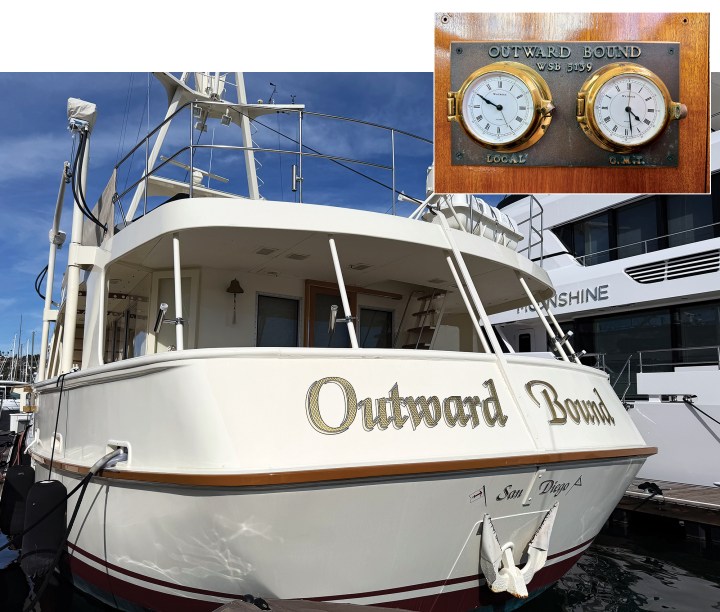
The story of Outward Bound began in the imagination of Bill Boeing of Boeing Aerospace Company. In the late 1960s, he envisioned a yacht capable of long-range travel and extended, off-grid cruising that would blend in with the Pacific Northwest working fleets. He got in touch with Jack Hargrave and Hatteras just after the North Carolina-based builder decided to build a fiberglass shrimp trawler. Hatteras sold Boeing a bare, 76-foot hull.
This singular expeditionary trawler measures 76 feet with a 23-foot beam, an 11-foot draft and an extraordinary A/B ratio of 1:1, which classifies her as a true bluewater passagemaker according to Robert Beebe’s Voyaging Under Power (A/B ratio refers to the vessel’s area above water versus area below water. The smaller the ratio, the better).
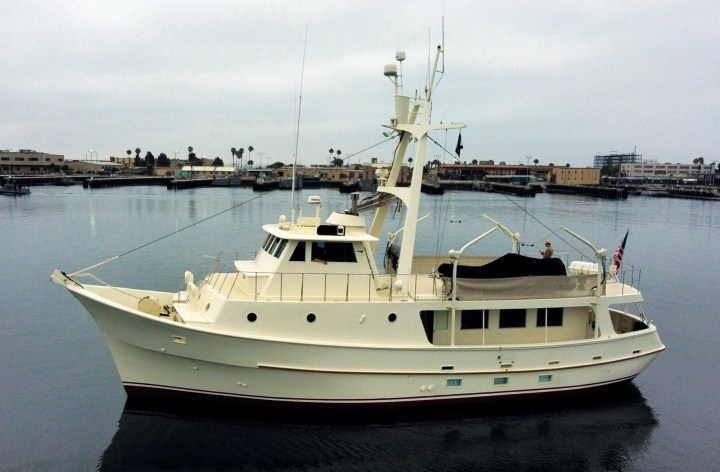
The American aviation pioneer was able to procure technology that few others could, such as parts from 747 aircraft for the yacht’s electrical system. Outward Bound was also outfitted with Jered Industries frictionless gyrostabilizers, previously only available for U.S. Navy vessels.
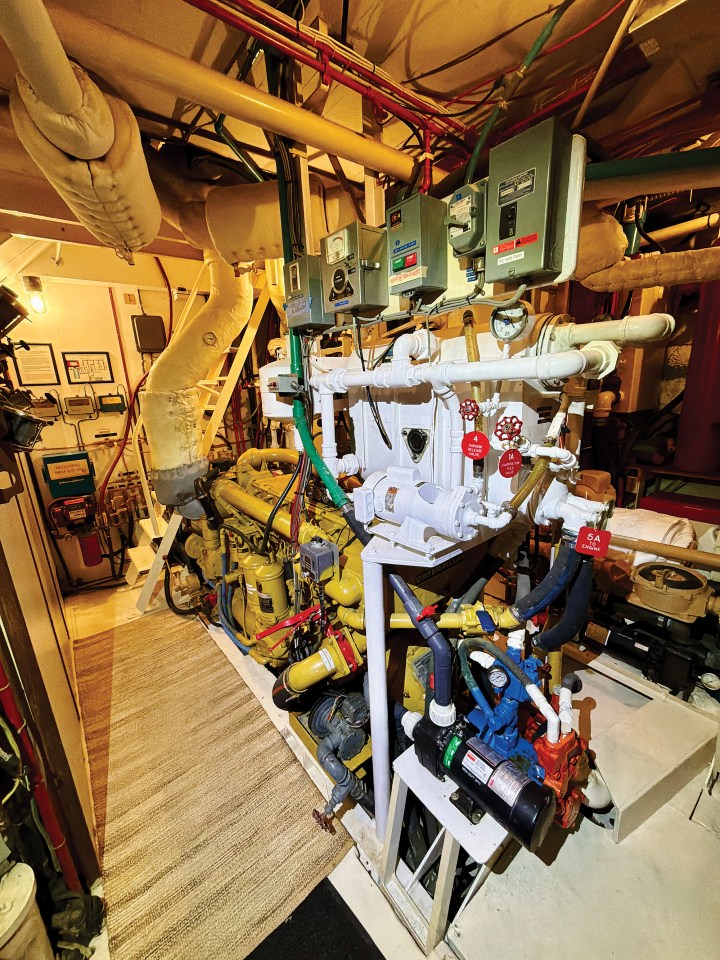
In the engine room is a Caterpillar D343 engine with a 6:1 reduction gear and a dry-stack exhaust. Her big prop can turn at 250 rpm with little to no noise (or fumes) on the main deck level at cruise speeds. Three generators—two 15 kW and one 30 kW—run hotel services, while an 80 amp AC generator built off the main engine produces power for the mechanical spaces. Off the main flywheel, a hydraulic power takeoff operates the windlass, bow thruster and boat davits.
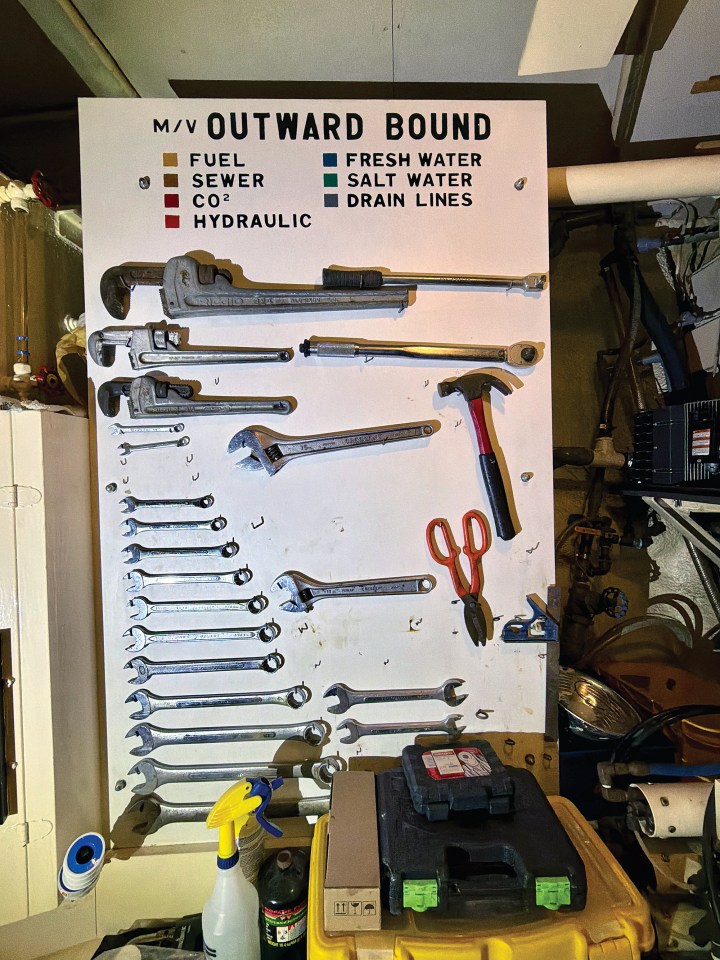
Fantastic bits of marine engineering continue throughout the machinery spaces. A high-output Maxim desalination unit produces 100 gallons of potable water per hour by boiling seawater using waste heat from the main engine. Outward Bound also has a standard reverse osmosis watermaker for redundancy. Heat and air conditioning come from a 400,000-BTU boiler and a four-cylinder, 6-hp Tecumseh pump, respectively, providing efficient climate control within the yacht’s 6-inch insulated hull.
For such a heavy-displacement vessel, ground tackle must be nothing shy of robust. Outward Bound carries a 1,200-pound Danforth anchor coupled to 60 feet of ¾-inch link chain and 600 feet of ¾-inch cable. The anchor and chain alone allow for 1 ton of steel to be placed on the seafloor. For tight anchorages, a stern anchor has its own windlass mounted in the lazarette.
There’s room to carry two tenders on the boat deck, and the yacht has two at-sea fueling pumps with hoses longer than 50 feet. They allow Outward Bound to act as the fueling station for a small flotilla.
Upon christening Outward Bound, Boeing cruised extensively from Seattle to Sitka, Alaska, before putting the yacht on the brokerage market in the early 1990s. Enter Richard Fantozzi, a seasoned yachtsman who was preparing to convert a commercial boat into a bluewater passagemaker. Fantozzi couldn’t believe what he was reading: 11,000 gallons of fuel, 3,000 gallons of water and a 1,000-gallon holding tank. All on a 76-foot vessel.
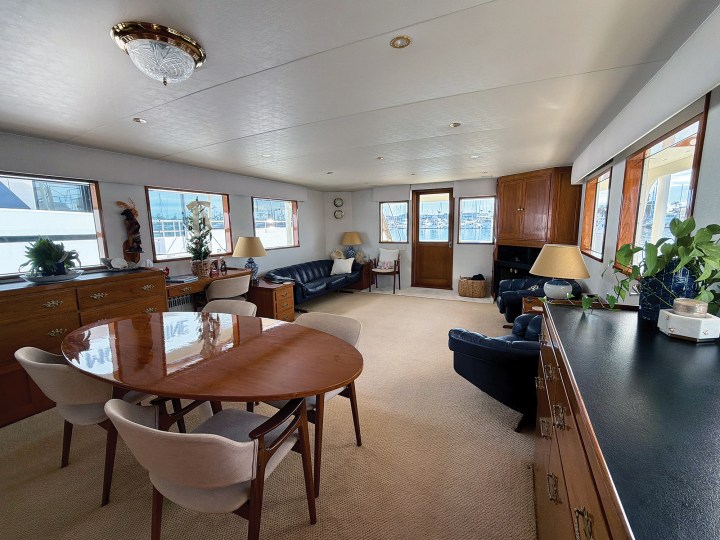
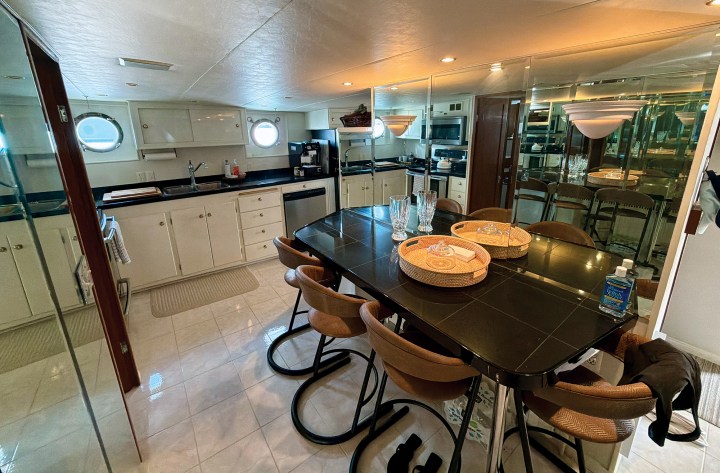
Fantozzi purchased Outward Bound in 1993. He hired yacht carpenter David Black to reappoint the three crew cabins and renovate the galley to maximize comfort and family-style dining. “The old galley was a fishing-boat galley,” Fantozzi says. “We wanted to modernize it and create a place where we could sit and dine and recreate in the galley space, with the chef.”
After the fish holds were removed, the lower decks were built into three en suite staterooms, including a master aft. Fantozzi says he remembers guests riding in relative comfort in the lower cabins amid stormy seas off Mexico’s Socorro and Clarion islands, thanks to the excellent stabilization and deep draft of the boat.
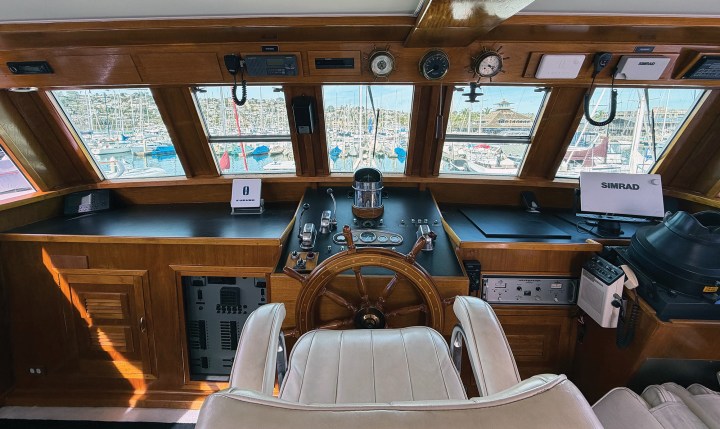
The pilothouse retains a blend of commercial utility and classic yacht styling. Analog gauges and a ComNav autopilot live in harmony with a modern Simrad navigation suite and varnished wood cabinetry. High above the galley, the pilothouse has excellent sightlines and has never seen green water in Fantozzi’s years of ownership.
Outward Bound still has impressive cold stowage, with a household refrigerator and cold-plate refrigerator/freezer in the galley, a cold-plate freezer in the generator room, and another freezer farther forward in the stem. These freezers, paired with proper fishing gear and a full-size pantry, allow for weeks of self-contained exploration.
Fantozzi and crew have cruised all along the Pacific coast from Canada to southern Mexico, Socorro, Zihuatanejo, Guadalupe Island and “every bahia and anchorage they could find.” He recalls a harrowing experience outside of Neah Bay, Wash., with 25- to 30-foot seas and howling winds. Sighting a rogue wave approaching from astern, the captain jumped 14 feet down the pilothouse ladder to ensure the aft-facing doors were dogged tight. He then made sure the engine-driven bilge pumps were online, just in case.
The 80-foot wave crashed through the stern, blowing out the wing doors on the side decks but causing no further damage. “After the wave, she carried on as if nothing unusual had happened,” Fantozzi says.
Once dubbed “the slowest Boeing,” Outward Bound’s cruise speed ranges from 8 to 11 knots. She continues to cruise locally around her home port of San Diego, a gleaming example of function and style, with the bones and comfort to carry her passengers safely for decades to come.
This article originally appeared in the October 2026 issue of Passagemaker magazine.