You may wonder why I’m writing about bilge pumps in a boat handling column. It’s because I believe boat handling isn’t limited to what happens at the helm. It also entails the systems that keep your boat safe and controllable before you ever cast off the lines. After all, it’s difficult to handle a boat that’s taking on water.
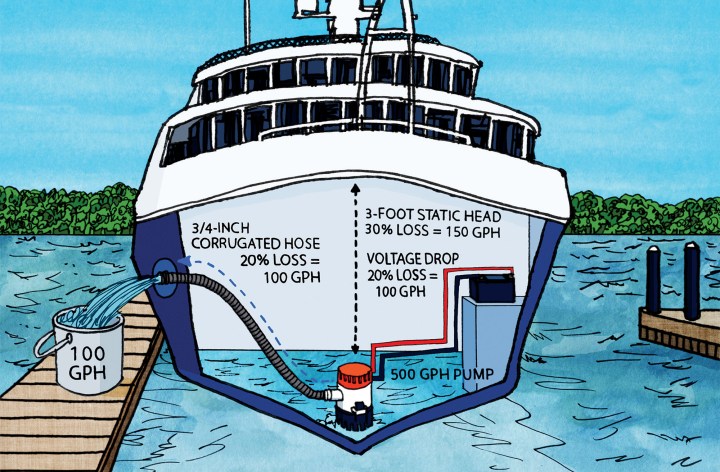
A recent discussion on a trawler owners’ forum convinced me that many boaters misunderstand the purpose of the bilge pumps aboard their boats. Judging by the comments, a surprising number believe that if a hose fails or the hull is damaged, the bilge pumps will simply keep up until help arrives.
Unfortunately, that’s not what bilge pumps were designed to do. Their primary purpose is much less dramatic.
Bilge pumps remove small amounts of water that normally find their way into a boat during everyday operation. Engine cooling systems, air-conditioning condensate, shaft seals on older boats, rainwater intrusion and the occasional plumbing drip all contribute to water collecting in the bilge.
Because this accumulation of water is not unusual, many owners install pump cycle counters that record how often they operate. An increase in cycling frequency is often the first indication that something is wrong. In that sense, the bilge pump isn’t just removing water; it is also serving as an early warning system.
Dangerous Misconception
Most recreational boats intentionally have multiple holes below the waterline, as multiple systems require through-hull fittings. These openings are perfectly safe when they are controlled by properly maintained seacocks, hoses and clamps—until something fails. A deteriorated hose, a cracked fitting or a failed hose clamp can quickly change a controlled water intake into an uncontrolled flood.
Even worse is damage to the hull itself. This is where many boaters mistakenly assume their bilge pumps become emergency dewatering pumps. The numbers tell a different story.
A hole only ½-inch in diameter located 1 foot below the waterline allows roughly 5 gallons of water into the boat every minute. Increase that to 1-inch hull 4 feet below the waterline, and the inflow approaches 40 gallons per minute. Those numbers surprise most boaters because the openings seem so small.
Now, compare those inflow rates with the actual capacity of many factory-installed bilge pumps.
Pump manufacturers advertise capacities measured under ideal laboratory conditions with no discharge hose attached and no vertical lift. Real boats never operate under those conditions. Every foot the pump must lift water upward through the discharge hose reduces its actual output. Hose length, bends, fittings and low battery voltage reduce it even further.
The result is that many pumps installed on recreational boats deliver only a fraction of their advertised capacity. They are still perfectly acceptable for removing nuisance water, but they may be inadequate for controlling a serious leak. They were never designed to keep your boat from sinking.
This is one reason experienced offshore boaters frequently carry a portable, high-volume emergency dewatering pump. These pumps aren’t intended to replace the installed bilge pumps. They supplement them during the kind of flooding event the standard pumps were never designed to handle.
Aboard our trawler Liberdade, we carry a high-volume dewatering pump with 50 feet of 2-inch hose coiled and ready for action. The pump is easily lowered into the flooding compartment, and the hose would go out a porthole or hatchway overboard.
While it’s prudent to equip your boat to handle a flooding situation, the best solution, of course, is preventing flooding in the first place.
Through-hull fittings and their associated hoses are among the most neglected systems aboard many boats, despite consistently ranking among the leading causes of insurance claims involving sinking at the dock. Seacocks should be exercised regularly so they continue to operate smoothly. Hoses should be inspected for age, cracking, softness or abrasion. Hose clamps deserve the same attention. Preventive maintenance is always easier than trying to out-pump an incoming flood.
More Attention
Ironically, the bilge itself is often the most neglected part of the boat. The word “bilge” carries a negative reputation. It is dark and difficult to reach, and frequently contains a witches’ brew of water, oil residue, coolant, dirt and microbial growth. It’s understandable why many owners avoid it.
A clean bilge makes small problems much easier to find before they become expensive ones. By keeping Liberdade’s bilges completely dry, we know that just a single drop of water triggers our sensors, giving me the opportunity to investigate its source before it becomes gallons.
Don’t assume your bilge has to contain water. Modern boats equipped with dripless shaft seals often remain nearly dry. If your air-conditioning condensate drains into the bilge, consider routing it into a sump box instead. Make sure engine compartments have proper containment for oil or coolant leaks so those fluids aren’t pumped directly overboard. Absorbent pads beneath engines protect the environment and often pinpoint the exact location of a developing leak.
Clean bilges also make it easier to inspect another often-overlooked feature: limber holes.
These small drain openings through structural members allow water to migrate toward the lowest point where the bilge pumps are located. Unfortunately, they also become collection points for screws, cable ties, wood chips and other debris that inevitably find their way into the bilge. Blocked limber holes can trap water in unexpected locations, while loose debris can eventually be carried into the bilge pump itself. Foreign objects jamming pump impellers remain one of the most common causes of pump failure.
Even a perfectly functioning pump is useless if it never turns on. Most recreational boats rely on automatic switches to activate the pump when water reaches a certain level. Most use a type of float switch, while others detect water electronically through conductivity. Both deserve regular inspection.
Float switches should move freely without anything restricting their travel. Electronic sensors should remain clean and free of corrosion. Wiring connections should also be inspected periodically because corrosion creates resistance, and resistance creates failures.
On a scheduled basis, manually activate each pump and verify not only that it runs, but also that any associated helm alarms or indicator lights function properly. Discovering a failed switch while tied to the dock is a minor inconvenience. Discovering it while the boat is filling with water is something else entirely.
Bilge pumps are valuable equipment, but we should appreciate them for what they are rather than expecting them to perform miracles. Their job is to remove small to moderate accumulations of water, provide early warning when something changes, and buy valuable time while you solve a problem. It bears repeating: They are not emergency dewatering pumps.
Understanding the limitations of your bilge pumps, maintaining them properly and preventing flooding in the first place won’t make you a better helmsman. But it will make you a better skipper. And that’s every bit as much a part of boat handling as knowing when to shift into reverse.
This article originally appeared in the October 2026 issue of Passagemaker magazine.